Summary
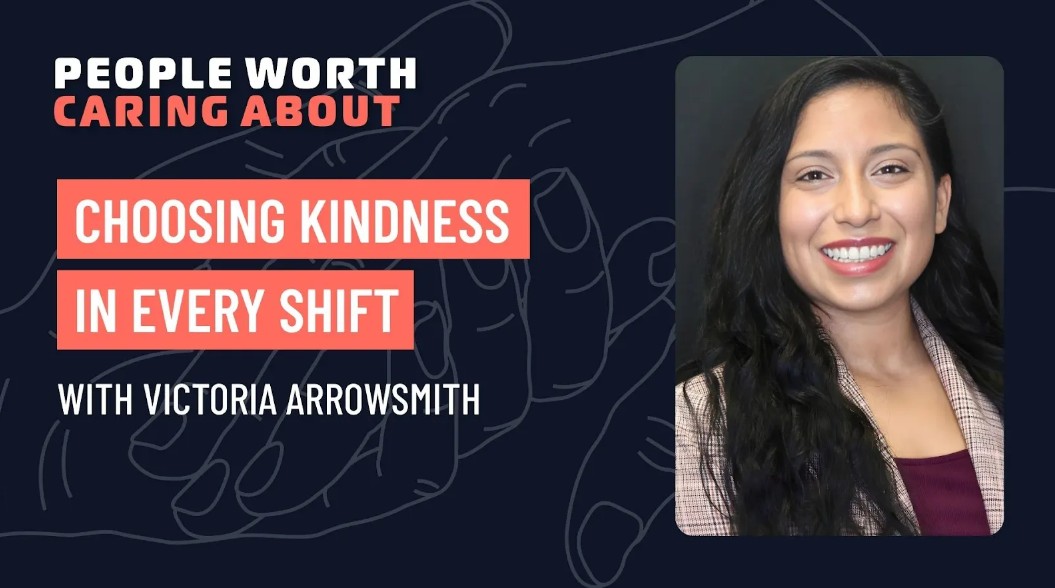
In this episode, Victoria Arrowsmith, a Certified Nursing Assistant of Brookestone of Papillion, shares her inspiring journey from high school science teacher to health care professional. Her career transition during the COVID-19 pandemic led her to discover profound purpose through patient care and human connection in long-term care settings.
Key Takeaways:
(00:00) Introduction.
(02:40) Career transitions can open unexpected paths to purpose.
(03:00) Global crises can catalyze meaningful personal transformations.
(03:52) Genuine human connections form health care’s most powerful foundation.
(04:44) Small compassionate gestures create lasting impacts on patients.
(06:12) True leaders inspire others to pursue growth opportunities.
(06:40) Thoughtful acts of kindness matter most during grief.
(07:52) Confronting mortality reminds us to cherish loved ones.
(08:40) Early exposure to compassionate care can shape vocations.
Resources Mentioned:
Brookestone of Papillion website
Thank you for listening to “People Worth Caring About.” If you found value in this episode, please subscribe and leave a 5-star rating to help others discover these important stories.
For more information and to connect with our guests, visit PeopleWorthCaringAbout.com.
Listen on Apple | Listen on Spotify | Watch it on YouTube
Transcript
Victoria Arrowsmith: Health care is a human-centered field, and so, seeing that death is definitely a part of it. That's part of medicine. It's part of health care. It's a part of life. I mean, I feel like that's something we all know, but it's really made it real, the mortality of life.
Peter Murphy Lewis: The world does not run on headlines. It runs on people who care. I'm Peter Murphy-Lewis, and this is "People Worth Caring About." Alongside my co-host, Jalene Carpenter, we sit down with the unsung heroes, caregivers, healers, helpers, the ones doing the real work, even when no one is watching. These conversations are not polished. They're personal. Because behind every act of care is a story worth hearing. New episodes drop regularly. Get updates at PeopleWorthCaringAbout.com.
Victoria Arrowsmith: Hi, my name is Victoria Arrowsmith. I work at Brookestone of Papillion, and I'm a nurse aide.
Peter Murphy Lewis: Wonderful. Thank you. Welcome to the podcast, Victoria.
Victoria Arrowsmith: Thank you. Thank you for having me, and I appreciate being invited.
Peter Murphy Lewis: Do you have an idea why they invited you? Why did they want your story on this podcast?
Victoria Arrowsmith: So I got asked by my administrator, Ashley Walter, to apply to this Congressional Briefing Scholarship. So I went for it, wrote an essay, and got selected, which was a pretty cool experience, with Nebraska Health Care Association. And ever since, I've just kept getting invited back to do things.
Peter Murphy Lewis: I have 17 follow-up questions. What was your essay about?
Victoria Arrowsmith: About my experience as a nurse aide at our facility of Brookestone of Papillion?
Peter Murphy Lewis: Anything specific in that?
Victoria Arrowsmith: Gosh, I think I talked more about how I wanted to share my story of what it's like working in long-term care, kind of learn from... I don't know, I feel like I'm just dipping my toe in the water with things. So I've learned so much about issues and long-term care that don't only affect just my facility, but also the broader community, as well as this whole state of Nebraska as well.
Peter Murphy Lewis: Do you know why she told you to apply?
Victoria Arrowsmith: So I go to school. I'm a student, so I think probably that, and she knows I like to write and I'm pretty studious.
Peter Murphy Lewis: What are you studying?
Victoria Arrowsmith: So I am applying to medical school. That's my big goal. And that's kind of how I came into long-term care and becoming a nurse aide was it was a way for me to explore patient care and health care in general.
Peter Murphy Lewis: Did you know that you want to apply to medical school when you became a CNA?
Victoria Arrowsmith: I did. I think that was kind of always the long-term plan, but also wanted to be for certain. I mean, I was also still curious about exploring the nurse role as well. So I mean, I came from... I used to be a teacher, so that was my career background previous.
Peter Murphy Lewis: What'd you teach?
Victoria Arrowsmith: I taught science. But yeah, it was just kind of, like, "Let me just... I want to change careers. Let me try this out, see if..."
Peter Murphy Lewis: Elementary, high school?
Victoria Arrowsmith: High school science.
Peter Murphy Lewis: Wow. What a change.
Victoria Arrowsmith: Yeah, it was a big change, and it was right in the midst of COVID, and that was really probably the biggest push. And I think that kind of pushed a lot of people to make changes because, I mean, it changed the world.
Peter Murphy Lewis: Well, a lot of people left long-term care and you went into long-term care.
Victoria Arrowsmith: Well, it was one of the few places I could work because the school's shut down. I remember that I applied... Well, I had just gotten my nurse aide certification, applied for this job. They called me back, and I was doing my orientation during my spring break of March 2020, expecting fully to work part-time and then go back to my teaching during the week, and the next week and, well, the school's closed, and so, I was like, "Well, I guess I'll be nurse aiding full-time right now."
Peter Murphy Lewis: And what about your work as a nurse aide confirmed that you wanted to stay in health care that you would then apply to med school?
Victoria Arrowsmith: It is truly the connections with people. I remember even during COVID, I mean, there were just definitely was isolating for a lot of people. I saw that because residents weren't able to have their families come in. It was pretty closed off. But I remember there being little connections we could make with people to kind of make their day still. And even, we were limited even as nurse aides to go into people's rooms.
I mean, it was having to gown up and then trying to limit our time inside or even going. So we would be a lot of times outside of people's rooms. And I remember one resident we had, and this was when I was just a brand-new, baby CNA, but one resident, I think she was like first door on the left on this one hall, but I'd always say after I tuck her in, and then I'd leave, but I'd kind of help tell her a bedtime story. So there's just those little nice compassionate connection that you can make with people.
Peter Murphy Lewis: This show is powered by AAG Health, the team behind the teams. If you are building a care team that actually cares, nurses, doctors, techs, admin pros, AAG doesn't just fill jobs. They find people who show up and stay. Visit AAG.health and see how fast the right people can make all the difference.
You and I have something in common. If I remember correctly, some of the information you shared beforehand, if I asked you who are some heroes, who are some influencers? In my talk today, I shared who was big in my life is Robert, who trained me to be a CNA, Chris, who was in the documentary, "People Worth Caring About" in Nebraska. Who were the influencers that you wrote down?
Victoria Arrowsmith: So that was the hardest question, I think, for me to answer because so many people came to mind. I mean, having gone to DC last summer, I met so many leaders in the field of long-term care. I mean, having heard your story, I feel like you're an influencer totally. I thought my administrator because she planted the seed in me to apply for that Congressional Briefing scholarship, which just opened up a bunch of doors for this opportunity, I think. And that year, she inspired me to apply to this scholarship and applied to, or encouraged a bunch of other people at our facility to apply for Nebraska Health Care Association scholarships. And I think that year she had seven people from our facility win scholarships, so to me, that's totally influencer-worthy.
And then, a lot of the nurse aides at my facility. I mean, I look up to people who've trained me when I was just learning how to work on the floor. And then, my husband also works at our facility, and he was the person that I thought about when you were talking your keynote speaking of the one person who has a story that they're too humble to share.
Peter Murphy Lewis: Oh wow. What makes him extraordinary?
Victoria Arrowsmith: So he cooks at our facility, and he is totally humble and definitely shies away from limelight, but he also does little thoughtful things with people's foods, like making their breakfasts to their preference. He knows who gets an over-medium egg. But I know we had one resident who had passed, and I think was one of his favorites, and that morning that she'd passed, no one asked him to do this, but he made breakfast for all her family that was there.
Peter Murphy Lewis: Oh, wow. That's powerful. What's something that you learned about yourself working as a CNA that you hadn't learned before as a teacher or as a daughter, as a sister, as a wife? What has this work taught you?
Victoria Arrowsmith: I think, for me, it's really, health care is a human-centered field, and so, seeing that death is definitely a part of it. That's part of medicine. It's part of health care. It's a part of life. I feel like that's something we all know, but it's really made it real, the mortality of life. But I think what that taught me, it's more of, is to tell your loved ones that you love them all the time, to make the most of life, take opportunities and chances, be nice to people.
Peter Murphy Lewis: Is there somebody... Now that you're in long-term care, is there somebody in your past, in your family, that showed you these types of humble servant leadership, taking care of people, that you're like, "Oh, I kind of saw this when I was little. I didn't know I was going to be in long-term care." Or did you just have it inside you? No one showed you?
Victoria Arrowsmith: I mean, I didn't know I was going to go into long-term care. I guess I think of my grandma, who was always loving and accepting to everyone. I think my first little experience in long-term care was visiting her at her nursing home. I guess I didn't think it planted the seed, but now, looking back, I just remember how helpful her nurses and nurse aides were and how they loved her at that place. They truly did. I don't think those things really stuck with me until after I entered the field.
Peter Murphy Lewis: Victoria, you're so, so wise. You seem like you're 40 years younger than me, but you're 80 years old wiser than me. Thank you so much for joining me on the podcast. I'm so happy that somebody pushed you to apply. I'm so happy that you and your husband have become a force inside of a long-term care. I feel like in 20 years, we're going to see you on the big screen and you're going to be leading policy, and I'm glad you went to D.C and heard so much about this. Thanks for coming on the podcast.
Victoria Arrowsmith: Thank you so much for having me.
Peter Murphy Lewis: That's a wrap on People Worth Caring About, born from the documentary, built to keep the stories going. Shout out to Nebraska Health Care Association and Jalene Carpenter for helping launch it and to Ohio and New Mexico for making future seasons real. Watch the docuseries online or at peopleworthcaringabout.com, and if this episode meant something to you, leave a review. It matters. Take care of yourself and the people worth caring about.
#HealthcareLeadership #WasteManagement #SkilledTrades #PeopleWorthCaringAbout
