Summary
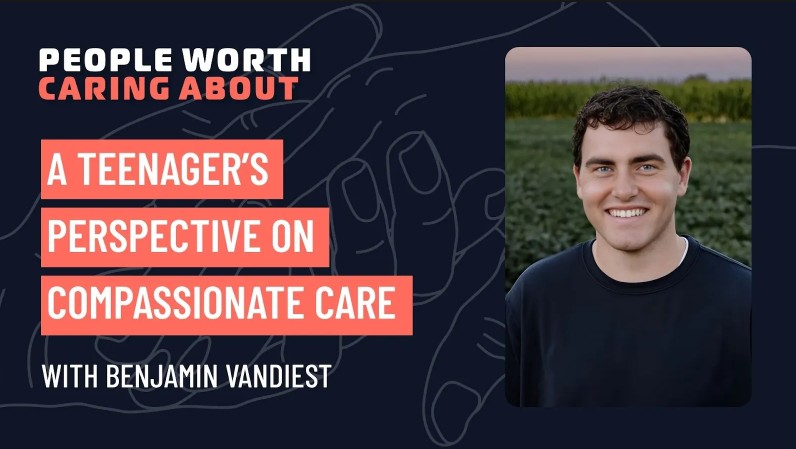
On this episode, host Peter Murphy Lewis talks with Benjamin VanDiest, a sophomore at the University of Nebraska Kearney and Certified Nursing Assistant at Mount Carmel Home. Benjamin shares his journey from a high school CNA class to discovering a deep passion for caregiving. He reflects on lessons learned from the elderly residents he serves and the personal inspiration he draws from his own family’s experience with caregiving.
Key Takeaways:
(00:00) Introduction.
(01:16) Taking a CNA class in high school sparked an early interest in health care.
(03:00) Overcoming first-day nerves and gaining confidence through mentorship.
(04:20) Discovering the deeper purpose behind caregiving and connection.
(05:32) Learning wisdom from residents who lived through major historical moments.
(06:36) Becoming more patient and gentle through daily interactions with elders.
(07:32) Drawing inspiration from his grandmother’s compassion as a lifelong caregiver.
Resources Mentioned:
Thank you for listening to “People Worth Caring About.” If you found value in this episode, please subscribe and leave a 5-star rating to help others discover these important stories.
For more information and to connect with our guests, visit PeopleWorthCaringAbout.com.
Listen on Apple | Listen on Spotify | Watch it on YouTube
Transcript
Benjamin Van Deist: First of all, health care is a great field. You get to go and work and change someone's life or be able to make an impact in their life. If that's from being a doctor, a PA, to the nurses, to the person that's running the test in the lab.
Peter Murphy-Lewis: The world does not run on headlines. It runs on people who care. I'm Peter Murphy-Lewis, and this is "People Worth Caring About." Alongside my co-host, Jalene Carpenter, we sit down with the unsung heroes, caregivers, healers, helpers, the ones doing the real work, even when no one is watching. These conversations are not polished. They're personal, because behind every act of care is a story worth hearing. New episodes drop regularly. Get updates at PeopleWorthCaringAbout.com.
Benjamin Van Deist: My name's Benjamin VanDeist. I'm a sophomore at University of Nebraska-Kearney, studying exercise science with a nutrition minor on the pre-physician assistant track. In my senior year at high school I got my CNA license, and I finally decided to use it this summer at Mount Carmel Nursing Home here in Kearney. And so, I'm just going to come tell you about my story.
Peter Murphy-Lewis: That is awesome. That's the best one so far, Benjamin. Tell me, why did you decide to study to become a CN- Why did you become a CNA in high school?
Benjamin Van Deist: So to begin, I took my CNA classes through my high school and taught through my high school nurse, and it was through one of the local community colleges. I was like, well, to be a PA, you need patient contact hours. And I thought CNA would come in useful. It builds a lot of skills, communication, builds compassion skills, and just being able to take care of a person. And so, I was like, "Well, I'm really not doing anything." And so I took it, pass everything, and then I did not work my freshman year of college.
And so then it was kind of expiring, so I was like, let me use it. And so I went, reached out to Mount Carmel and applied and got the job. And it's been good since day one. I've rotated through all their floors, they've got like a, I like to call it a swing bed unit. They're there because they've had an injury, like a hip, a stroke, and they're just there for physical therapy, OT, then they go home.
Then you have your true assisted living, and then they have a memory unit. And I've been in all three. And it's just been good to see all three, because they're all different aspects of, like, elderly. You have your unit memory care, and that's a little more challenging, per se. But it's also fun to see the growth and stuff. And then, especially swing bed's one of my favorite because they're really motivated to go home, because they can return home. And so it's just fun to track their progress and just be able to help them even when they're on their lowest of lows, some days.
Peter Murphy-Lewis: Were you a little bit intimidated, having passed your exam about a year ago, afraid that you might forget some of the terms, some of the SOPs, some of the things you need to follow?
Benjamin Van Deist: For sure. And even the first couple times, I had to really knock off a lot of rust, but as I continued, I trained with someone. They didn't just turn me loose. But it was still kind of came back to me, "Oh," kind of, "Oh, I remember doing this. Oh yeah, this makes sense."
And a lot of it was just, I might've been scared but I couldn't show it to the resident. It was maybe being like, "Hey, how are you doing today?" And just striking up a conversation to kind of ease my nervousness and not make them so worried. Because a lot of them know that I was new, and they'd ask me about it, and a lot of them are really good about, "Well, here's how they do it, but you're still doing a good job." They were still all very supportive. And even my CNAs I trained with, the nurses I worked with, they were all super nice, because everyone started where I was. So it just took some time.
Peter Murphy-Lewis: Benjamin, you might be the youngest guest that I've had on the podcast, People Worth Caring About. How old are you?
Benjamin Van Deist: I'll be 20 on September 15th. So my birthday's coming up.
Peter Murphy-Lewis: All right, congratulations. Happy birthday.
This show is powered by AAG Health, the team behind the teams. If you are building a care team that actually cares, nurses, doctors, techs, admin, pros, AAG doesn't just fill jobs, they find people who show up and stay. Visit aag.health and see how fast the right people can make all the difference.
What would you say to the 18-year-olds out there who might hear this or the mom and dad who has a child who's 18, why they should give this a chance? What could they learn?
Benjamin Van Deist: So first of all, health care is a great field. You get to go and work and change someone's life or be able to make an impact in their life. If that's from being a doctor, a PA, to the nurses, to the person that's running the test in the lab.
And so, one of the parts of that is being a CNA, and it might be terrible work, but at the end of the day, it's also kind of rewarding too, being able to go in and talk to them, and their daughter or sister might be in there. And then you come in later and you'll be like, "Well, hey, I saw that your sister was in there today. Well, what did you talk about?" Or, "Tell me a little bit more about yourself."
And so then it kind of distracts them, if they're having a bad day, or just getting to be able to connect with the residents was one of my favorite things to do. Then as a CNA, it just teaches you so many skills. One, this teaches you, it kind of motivates you to do good in school, because you can use your CNA as like a stepping stone to become a PA, doctor and just stuff like that. But really, at the end of the day, it's about being able to make an impact on their lives, is really what I enjoy.
Peter Murphy-Lewis: Have you created any unique relationships with a senior or a resident, that you didn't expect yourself to kind of connect as much as you have?
Benjamin Van Deist: Yeah, there's a couple I've really, really kind of... Not taken under my wing, but kind of like that. And I've really enjoyed getting to know them, and they're really telling me about their families. One just turned a hundred couple of weeks ago, and so has been able to learn what they did growing up compared to my time. They lived through the Great Depression. They lived through both World Wars. They lived through the 9/11 terrorist attacks. They lived through the COVID Pandemic. And just being able to take wisdom from them and be able to learn because they're full of knowledge.
Sometimes people think you put the residents, the elderly away and you don't get to see them. Well, there are a lot of them in there are full of knowledge, and they're willing to share their advice that they have. So it was really cool to learn from that and stuff.
Peter Murphy-Lewis: Do you know if you want to go into acute or long-term care, or are you figuring that out?
Benjamin Van Deist: If I was to decide today, it'd probably be orthopedics first. I'm a big sports fan, especially Husker football, and all college athletics in general. But it has kind of changed my mind, maybe a little bit. Keeping an open mind as I go through professional school and stuff.
Peter Murphy-Lewis: Outside of the professional work, how has it impacted you as a human being? How do you see somebody who's 80, 90, or someone who just turned a hundred, differently than maybe you did a year ago?
Benjamin Van Deist: Working, being around them all the time, just being a little more gentle and more patient with individuals. They're older, so they might take a little bit more time walking to the dining hall. You have to take slower steps. Helping them transfer. They have a little thinner skin, so you have to be a little more gentle, kind of like a gentle giant kind of deal because I'm a little bigger than most of my residents.
But then, even like working, I also work in Hy-Vee, the grocery store and having my elderly come through and just being able to talk to them too and see what they're doing. And a lot of times they come through, and I'll be checking their groceries and then they'll start talking about, "Well, what do you do?" And then, so you kind of start talking about things with them. So just being able to be gentle and patient with them and just have a good time with them. You know, create memories.
Peter Murphy-Lewis: Benjamin, as we start to wrap it up, is there anybody in your life, maybe a parent or a grandparent or uncle or a neighbor, who kind of gave you this big heart where you want to help people every single day?
Benjamin Van Deist: So being a CNA, you're the front line to everything. You report everything to the nurses that you see, behaviors, like bruises or anything like that. And just being able to show up, show compassion, because you are like their caregiver.
And so I see that every day with my grandma. My grandpa has MS and is completely chair bound, and he's fortunate to be able to stay at home because my grandma takes care of him. And he's quite bigger than her, but she has still, through multiple surgeries, been able to still take care of him. So I see that on a firsthand daily basis. Because without him and her unconditional love, it might be a different story for him. So that's what I see every day.
Peter Murphy-Lewis: Oh, that's lovely. Thank you so much, Benjamin, for joining me on the podcast. I appreciate it.
Benjamin Van Deist: Appreciate it. Thank you.
Peter Murphy-Lewis: That's a wrap on "People Worth Caring About." Born from the documentary, built to keep the stories going. Shout out to Nebraska Health Care Association and Jalene Carpenter for helping launch it and to Ohio and New Mexico for making future seasons real. Watch the docuseries online, or at PeopleWorthCaringAbout.com. And if this episode meant something to you, leave a review. It matters. Take care of yourself and the people worth caring about.
#HealthcareLeadership #SkilledTrades #PeopleWorthCaringAbout
