
In 2026, healthcare facilities and HR leaders are facing one of the most difficult staffing environments in recent years. The U.S. is projected to face a shortage of more than 187,000 physicians by 2037, with family medicine, internal medicine, and emergency medicine among the hardest hit specialties.
To manage growing coverage gaps, more systems are turning to flexible staffing models. Nationwide, locum tenens usage has risen by more than 25% as organizations try to maintain patient access, protect full-time teams, and control operational strain.
In this article, we will break down the most in-demand locum tenens specialties for 2026. We’ll show you what they are, why they matter, and where they can make the biggest difference in your healthcare system.
P.S. Struggling to keep critical specialties staffed without burning out full-time clinicians or compromising patient care? AAG Health can help you secure reliable locum tenens coverage by matching the right clinicians to your needs with precision, compliance, and speed.
What is locum tenens?
Locum tenens refers to short‑term clinical assignments where physicians, nurse practitioners, physician assistants, and advanced practice providers step in to cover gaps in patient care.
These assignments can run from a few days to several months, depending on your facility’s needs. The term itself means “to hold the place of,” which is exactly what these professionals do when a permanent provider is unavailable.
Locum tenens is a more common strategy than you might expect. In 2024, about 81 percent of facilities reported using locum tenens clinicians.
Benefits of locum tenens for healthcare facilities
For recruiting teams, clinical leaders, and HR execs, locum tenens can be a flexible, cost-conscious way to keep patient care running without overextending your core team.
Here’s how it delivers:
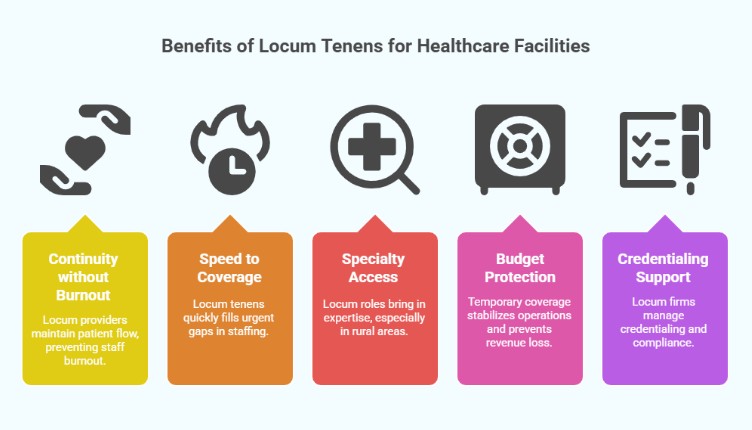
- Continuity without burnout: Locum providers help maintain patient flow when permanent staff are out on leave, retiring, or hard to find. That keeps schedules stable without pushing your full-time team to the edge.
- Speed to coverage: Traditional physician hiring can take 6-12 months or more. Locum tenens speeds things up and lets you close urgent gaps in weeks.
- Specialty access where it’s scarce: Whether you need neurology coverage, pediatric support, or locum anesthesiologists, short-term roles can bring in expertise you may not have in-house, particularly in rural or underserved regions.
- Budget protection: Unfilled physician roles can cost hospitals up to $2.6 million in lost annual revenue per vacancy, especially when they affect surgical specialties or high-demand departments. Temporary coverage helps stabilize operations and keep services open.
- Credentialing and compliance support: Reputable locum firms like AAG Health manage everything from DEA registration to state medical board requirements, which helps you stay compliant with important laws.
11 In-Demand Specialties for Locum Tenens for 2026
Now let’s take a look at 11 of the most in-demand and rewarding specialty areas for locum tenens in 2026.
1. Emergency medicine
Emergency medicine is focused on diagnosing, treating, and stabilizing patients who arrive with acute conditions, trauma, or undifferentiated symptoms that can’t wait for traditional appointments.
Emergency medicine physicians, physician assistants, and nurse practitioners manage everything from heart attacks and strokes to injuries and sudden illnesses. Care is typically delivered in high-pressure hospital emergency departments and freestanding urgent care centers.
Why is it in demand?
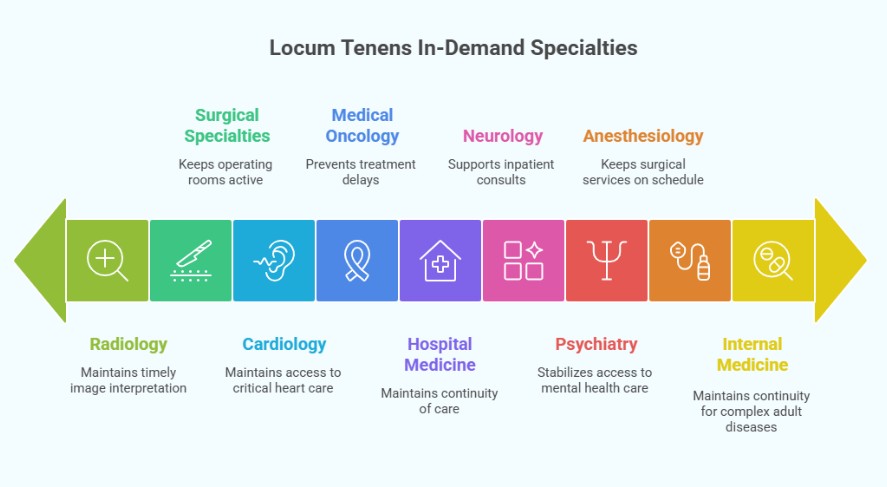
Visits to emergency departments continue to rise while many facilities struggle to staff 24/7 coverage. Staffing gaps become even more pronounced when permanent clinicians are unavailable or experiencing burnout.
Because emergency departments mostly serve as the front door to the healthcare system, interruptions in coverage can disrupt patient care and strain hospital revenue. This makes reliable locum coverage a priority for healthcare leaders and staffing teams.
2. Family medicine
Family medicine is a broad primary care specialty focused on comprehensive, continuous care for patients of all ages. Family medicine physicians, nurse practitioners, and physician assistants diagnose and treat common acute conditions, manage chronic illnesses, coordinate preventive care, and act as a key entry point into the healthcare system.
Why is it in demand?
Family medicine remains essential because primary care forms the backbone of ongoing patient care, from chronic illness management to preventive services. Yet demand is growing faster than supply.
In our experience working with healthcare organizations across different regions, we’ve seen family medicine vacancies create immediate pressure on referral networks, care coordination, and patient access. When primary care coverage is limited, delays ripple across the entire system.
Locum family medicine providers help stabilize these pressure points by maintaining access to care during recruitment gaps, provider transitions, or periods of unexpected demand.
From what we’ve observed, even short-term coverage can protect continuity and prevent downstream strain on specialty and hospital-based services.
Pro tip: If you are struggling with family medicine vacancies or coverage gaps, AAG Health’s Locum Tenens Staffing for Family Medicine services can help. We secure dependable locum tenens support without adding administrative burden to your team.
3. Internal medicine
Internal medicine focuses on the prevention, diagnosis, and treatment of complex adult diseases. Internal medicine physicians and advanced practice providers manage multiple chronic conditions, interpret diagnostic findings, coordinate care across specialties, and serve patients with complicated health needs in both inpatient and outpatient settings.
Why is it in demand?
The need for internal medicine expertise continues to rise as more adults live longer with multiple chronic conditions such as heart disease, diabetes, and COPD. In fact, 2023 data show that 76% of U.S. adults reported at least one or more chronic condition.
As Eva H. DuGoff of the Johns Hopkins Bloomberg School of Public Health says,
“Living with multiple chronic diseases such as diabetes, kidney disease, and heart failure is now the norm and not the exception in the United States,”
From what we’ve seen working with healthcare teams, even short gaps in coverage can affect quality metrics, care coordination, and patient satisfaction. Because these clinicians manage patients with multiple interacting conditions, continuity is critical.
Locum internal medicine providers help you maintain continuity and keep things stable across care settings.
4. Anesthesiology
Anesthesiology is the medical specialty that provides anesthesia care before, during, and after surgical procedures, as well as pain management and critical support in operating rooms, procedural suites, and intensive care units.
Locum anesthesiologists and advanced practice anesthesia providers (such as certified registered nurse anesthetists) play key roles in ensuring that surgical services stay on schedule and that patients receive safe, effective care throughout perioperative care.
Why is it in demand?
The need for anesthesiology services is rising as surgical volume grows and the population ages, even though the anesthesia workforce is not expanding as fast as demand.
In fact, the United States is projected to face a shortage of about 6,300 anesthesiologists by 2036, driven by growing surgical needs and workforce attrition.
Because anesthesia services are essential to the revenue‑generating core of surgical specialties, gaps can disrupt procedures, affect patient satisfaction, and slow hospital collections. Locum tenens anesthesiology clinicians help keep care moving.
P.S. Need reliable anesthesia coverage without delaying procedures or overloading your team? AAG Health’s anesthesiology locum tenens services connect you with board-certified anesthesiologists and CRNAs who keep surgical care moving safely and on schedule.
5. Psychiatry
Psychiatry focuses on diagnosing, treating, and managing mental health conditions through therapy, medication management, and care coordination. Psychiatrists, psychiatric nurse practitioners, and psychiatric physician assistants work with patients across age groups to address mood disorders, anxiety, severe mental illness, and co‑occurring behavioral health needs.
Their work can happen in outpatient clinics, inpatient units, emergency settings, telebehavioral care platforms, and integrated care teams.
Why is it in demand?
Behavioral health needs continue to outpace provider supply. As of 2025, about 40 percent of the U.S. population lives in a mental health professional shortage area. This means access to care is limited or absent in many regions.
Even more specifically, the supply of adult psychiatrists is projected to shrink by roughly 20 percent by 2030 while demand rises, leaving a persistent gap in care delivery.
Because mental health services are essential to whole‑person care and usually tied to chronic illness management and emergency demand, gaps in psychiatric coverage can slow access and exacerbate patient acuity.
In our experience, locum psychiatry providers help you stabilize access and reduce operational strain when permanent staffing is unavailable.
6. Neurology
Neurology is the medical specialty focused on diagnosing and managing disorders of the nervous system, including stroke, Alzheimer’s disease, Parkinson’s disease, epilepsy, and multiple sclerosis.
Neurologists and advanced practice providers with neurology experience work across hospitals, outpatient clinics, multidisciplinary teams, and telehealth programs to treat complex neurologic conditions that require specialized expertise.
Why is it in demand?
Neurologic conditions are rapidly rising as the population ages. More than 6 million Americans are currently living with Alzheimer’s disease. And that number is expected to nearly double over the next few decades as baby boomers age, which is driving the ongoing need for neurologic care.
Because neurologic care involves complex diagnosis and ongoing management of chronic conditions, delays and interruptions can slow patient access and outcomes.
From what we’ve seen across different care settings, locum neurologists play a critical role by supporting inpatient consults, stroke programs, and specialty clinics when permanent coverage is unavailable. This flexibility helps you protect access, reduce backlogs, and maintain continuity of care during recruitment gaps or periods of rising demand.
7. Hospital medicine (hospitalists)
Hospital medicine is a specialty focused on caring for patients admitted to the hospital and managing their care from admission through discharge.
Hospitalists are usually physicians trained in internal medicine or family medicine who coordinate treatment plans, manage complex conditions, and work closely with specialists, nurses, case managers, and other clinical staff to keep inpatient care flowing smoothly.
Why is it in demand?
The hospitalist workforce has grown rapidly as hospitals rely on dedicated inpatient clinicians to keep care flowing smoothly. Research shows that the number of adult hospitalists in the U.S. grew by more than 50 percent between 2012 and 2019, and these clinicians now play a vital role in staffing most U.S. hospitals.
Inpatient care depends on consistent clinical oversight and coordination across specialties, so any disruption in hospitalist coverage can slow discharge throughput, affect quality metrics, and increase provider burnout.
Locum hospitalists help facilities maintain continuity of care, support care teams, and stabilize inpatient operations while permanent recruitment plays out.
8. Medical oncology
Medical oncology is the specialty focused on diagnosing and treating cancer using chemotherapy, immunotherapy, targeted therapy, and other systemic treatments.
Medical oncologists and hematology‑oncology specialists work closely with surgeons, radiation oncologists, radiologists, and advanced practice providers to develop and manage treatment plans that span from diagnosis through survivorship or palliative care.
Why is it in demand?
Cancer incidence continues to rise as the population ages, yet the distribution of oncologists is uneven and strained. According to the latest workforce snapshot from the American Society of Clinical Oncology, 68 percent of Americans aged 55 and older live in counties where medical and hematology oncologist coverage is at risk.
A big reason for this is that many clinicians are nearing retirement, and the workforce is unevenly distributed relative to cancer burden.
Locum medical oncologists play a critical role by supporting outpatient infusion centers, inpatient consult services, and continuity of cancer care when permanent coverage is unavailable.
We have noticed that flexible oncology coverage helps prevent treatment delays and maintain care plans during recruitment gaps or periods of increased demand.
9. Cardiology
Cardiology is the specialty focused on diagnosing and treating diseases of the heart and vascular system, including coronary artery disease, heart failure, arrhythmias, and hypertension.
Cardiologists and cardiology‑trained advanced practice providers work in hospitals, outpatient clinics, cardiac imaging centers, and interventional labs to guide patient care across preventive, acute, and chronic phases of cardiovascular disease management.
Why is it in demand?
Cardiovascular disease remains the leading cause of death in the United States, while access to cardiology specialists continues to lag behind patient need. Nearly half of all U.S. counties have no practicing cardiologist, which has left millions of Americans without local access to heart care and led to persistent coverage challenges for healthcare facilities.
Cardiovascular patients typically require ongoing monitoring, interventions, and care escalation, and locum cardiologists help facilities maintain access to critical heart care.
Locum cardiologists play a critical role by supporting inpatient consult services, outpatient clinics, and procedural coverage when permanent staffing is unavailable.
Need dependable cardiology coverage when staffing gaps arise? AAG Health’s locum tenens cardiology services connect you with board-certified cardiologists who help protect patient care and revenue.
10. Surgical specialties
Surgical specialties include a broad range of clinicians who perform operative procedures to treat injuries, illnesses, and diseases, from general surgery and orthopedics to vascular, thoracic, and other subspecialties.
Surgeons and advanced practice surgical providers work in hospital operating rooms, ambulatory surgery centers, and specialty clinics to deliver elective and urgent procedures.
Why is it in demand?
Demand for surgical care continues to grow faster than the available workforce across many specialties. National projections show a shortfall of between 10,100 and 19,900 surgical specialists by 2036, as a result of retirement waves among current surgeons, training bottlenecks, and rising procedure volumes as the population ages.
From what we’ve seen working with healthcare organizations, even brief gaps in surgical coverage can lead to postponed procedures, operating room downtime, and revenue loss.
Locum surgical specialists play a critical role by keeping operating rooms active, supporting call coverage, and maintaining procedural access when permanent surgeons are unavailable.
11. Radiology
Radiology focuses on diagnosing and sometimes treating patients using imaging technologies like X-rays, CT scans, MRIs, and ultrasounds. Radiologists interpret images, guide procedures, and collaborate closely with other specialties to confirm diagnoses or monitor treatment progress.
This category also includes interventional radiology and teleradiology, both of which are becoming increasingly critical in modern healthcare systems.
Why is it in demand?
Imaging demand continues to rise, with diagnostic imaging volumes projected to increase by 3–4% annually. At the same time, radiologist workforce growth remains limited due to retirements and training bottlenecks.
From what we have seen working with healthcare organizations, many systems face delayed read times, imaging backlogs, and service gaps as full-time radiologists reduce hours or retire. While teleradiology helps extend coverage, that talent pool is also increasingly stretched.
Locum radiologists help facilities maintain timely image interpretation, support both onsite and remote coverage models, and keep imaging departments compliant and operational during staffing transitions.
Facing imaging delays or radiologist coverage gaps? AAG Health’s locum radiology services place credentialed radiologists fast so your imaging schedules, turnaround times, and revenue stay on track.
How to choose the right locum tenens provider
For healthcare facilities, recruiting leaders and HR executives, a locum tenens partner should reduce risk, support patient care, and make your team's life easier rather than harder.
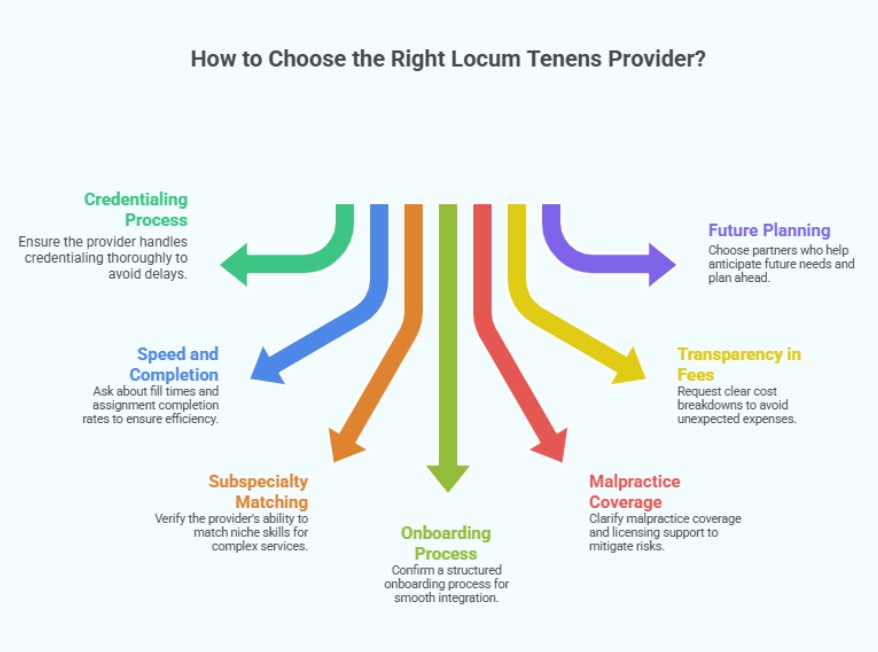
1. Ask how credentialing is handled and how issues are resolved
We’ve seen facilities stuck chasing down expired licenses or DEA registrations because a staffing partner failed to confirm credentials up front. When you ask how credentialing works and get vague responses like “we’ve got it covered,” that’s a signal to dig deeper.
Strong partners should walk you through how they verify everything, like state licenses, specialty case logs, DEA registration, and IMLC status, all before a provider ever sees your facility name.
A smart question to bring up is: “How often do credentialing issues delay start dates, and what’s your escalation process when that happens?”
2. Ask about speed to fill and assignment completion rates
Lots of agencies will tout how big their locums database is, but that doesn’t mean much if it takes 6 weeks to get someone credentialed or if half the clinicians don’t finish assignments.
We recommend asking how long it typically takes them to submit fully screened candidates, and what percentage of those actually start and complete the assignment. If they can’t give you hard numbers, that’s a red flag.
3. Dig into subspecialty matching for complex service lines
Subspecialty alignment matters, particularly for high-impact service lines. You do not want to discover gaps in experience after a clinician arrives on-site.
Ask how they vet candidates for niche skills such as oncology protocols, cath lab coverage, or high-acuity ED shifts.
A good answer includes specific sourcing strategies, prior case history, and references from similar assignments. Vague answers like “We’ll figure it out.” usually signal weak matching processes.
4. Make sure onboarding is structured and intentional
A smooth Day 1 makes all the difference. Yet too many agencies drop the ball when it comes to integration. There’s no EMR access plan, no site orientation, and no shift schedule alignment.
From what we have seen, when onboarding is rushed or unclear, productivity suffers in the first days of an assignment. If an agency cannot clearly explain how they prepare providers to be operational from day one, that is a signal to proceed carefully.
Ask directly: “What does your onboarding checklist include, and how do you coordinate with our team to make sure the clinician is operationally ready?”
5. Clarify malpractice coverage and licensing support upfront
There’s nothing worse than finding a great candidate, only to learn too late that they’re uninsured or nowhere close to having a valid state license.
Solid providers will tell you exactly what malpractice insurance is included (limits, claims-made or occurrence, etc.), how they handle license applications or IMLC processing, and who absorbs the cost. From our experience, transparency here prevents last-minute delays and unexpected risks.
If their answer is, “It depends,” without specifics, that is usually a signal to push for clearer answers before moving forward.
6. Look for transparency in pay rates and fees
If you’ve ever been blindsided by unexpected housing costs or administrative fees, you know how quickly “standard rates” can balloon. This becomes even more important when hybrid staffing models and vendor management are involved.
A reliable locum tenens partner should provide clear, line-by-line cost breakdowns rather than a single bundled figure. Transparency should include provider pay, travel expenses, lodging, and service fees.
A good test question: “Can you walk me through a sample invoice showing provider pay, travel, lodging, and your service fee separately?”
7. Choose partners who help you plan ahead
The strongest locum tenens partners do more than fill an open shift. They help organizations anticipate future coverage needs and plan ahead.
Ask how your partner tracks assignment trends, shares workforce insights, and supports medium- to long-term staffing planning. From our experience, agencies that only offer short-term fixes often leave teams reacting instead of preparing.
Partners who contribute forecasting support and strategic insight help facilities reduce last-minute scrambles and maintain more consistent coverage.
Partner With AAG Health for Reliable Locum Tenens Staffing
Staffing for locum tenens is about keeping patient care steady, reducing burnout, protecting revenue, and staying ahead of workforce disruptions. As we’ve seen, the most in-demand specialties for 2026, from emergency medicine to surgical subspecialties, aren’t getting easier to staff.
At AAG Health, we’ve built our model to serve exactly that need. With 400+ healthcare candidate inquiries daily, an average placement time of 55–90 days, and an 80% success rate on exclusive searches, we move with precision.
We’re ASA-certified, high-touch, and data-driven, and offer a 90-day replacement guarantee along with the kind of credentialing support that actually reduces your admin load. Whether you’re staffing urgent needs, scaling a program, or protecting shift coverage long-term, we’re ready to step in and deliver.
Ready to build a smarter locum strategy? Let’s talk.
FAQs
How long does it take to place a locum tenens provider?
It varies by specialty, but experienced partners like AAG Health typically deliver fully screened, credential-ready candidates in under 90 days.
Do locum tenens providers need separate licenses for every state?
Yes, unless they qualify under the Interstate Medical Licensure Compact (IMLC), which streamlines the process for multi-state practice.
Is locum coverage cost-effective compared to hiring full-time?
When factoring in revenue protection, reduced burnout, and patient access, locum tenens often delivers strong ROI, especially in high-demand specialties.
What roles can locum tenens providers fill?
Everything from frontline emergency medicine to surgical specialties, psychiatry, and advanced practice, including both inpatient and outpatient roles.
What makes AAG Health different from other staffing firms?
We combine high-touch service with a data-driven platform that generates 400+ healthcare inquiries daily, plus an 80% fill rate on exclusive searches.
Does AAG Health help with licensing, credentialing, and onboarding?
Yes, we handle end-to-end support, including state licensure, DEA registration, facility credentialing, and Day 1 onboarding checklists.
Does AAG Health offer any guarantee?
Yes, we offer a 90-day replacement guarantee, which is well above industry standard, because we’re focused on long-term fit, not just filling seats.
