Radiology departments across the globe are facing a breaking point as demand for medical imaging skyrockets and workforce pressures mount.
A recent global survey of more than 700 radiologists found that over half (53%) identify burnout as their top professional concern, far outpacing workforce shortages or brain drain.
In this article, we’ll explore how changing radiology working models, particularly remote and flexible arrangements, are reshaping the field, improving radiologists' well-being, and offering tangible benefits for diagnostic accuracy, retention, and operational resilience.
We’ll also connect the latest research to actionable strategies HR and recruiting teams can use to strengthen their teams, including how teleradiology plays a central role in future-ready staffing.
P.S. Struggling to cover imaging volume without burning out your in-house radiologists? AAG Health’s teleradiology recruitment services connect you with credentialed, remote-ready tele-radiologists who can step in fast and keep reads consistent.
The Growing Burnout Crisis in Radiology
Burnout in radiology has become a measurable, persistent problem that directly affects people, performance, and patient care.
Multiple studies show burnout prevalence in radiologists is consistently high.
A 2023 meta-analysis found that estimates of overall burnout reached up to 88%, with high burnout as much as 62% in some studies. Emotional exhaustion and depersonalization were among the most common contributors.
Earlier NIH research reported similar findings, with around 61% of radiologists experiencing burnout symptoms based on validated tools such as the Maslach Burnout Inventory.
The issue is also pronounced in private practice. One study found that nearly half of radiologists reported burnout, with those covering evenings, overnight shifts, and weekends affected most often.
These findings aren’t coming from informal surveys or opinion polls. They are based on validated assessment methods used across clinical medicine and published on PubMed Central, one of the most trusted medical research repositories.
So what’s driving the problem?
First, imaging volume keeps climbing, but staffing levels haven’t kept pace. CT scans, chest X-rays, and other medical scans are being ordered at higher rates across emergency departments, imaging centers, and outpatient settings.
Radiologists are interpreting more medical images per shift, often with little flexibility in case selection or workflow design.
Workload trends also back up the claim about increasing imaging volume and pressure. For example, ScienceDirect research tracking clinical workloads found that imaging utilization has grown steadily over the last decade. This has increased the interpretation workload for imaging professionals.
Second, long shifts and after-hours coverage take a toll. Overnight reads, weekend demand, and rotating call schedules disrupt sleep, recovery time, and work-life balance, especially for on-site radiologists working in traditional hospital workflows.
Then there’s the administrative burden. Fragmented radiology workflows, inefficient systems, and constant interruptions slow report generation and add cognitive load that has nothing to do with medical image analysis or diagnostic reasoning.
Finally, radiologists operate under intense diagnostic and medico-legal pressure. Every radiology report carries real consequences. Missed radiological features, delayed reads, or ambiguous findings can impact clinical diagnoses, downstream medical care, and legal exposure. Over time, that pressure compounds.
Check out the video below to see how remote MRI scanning can help address staff shortages in radiology:
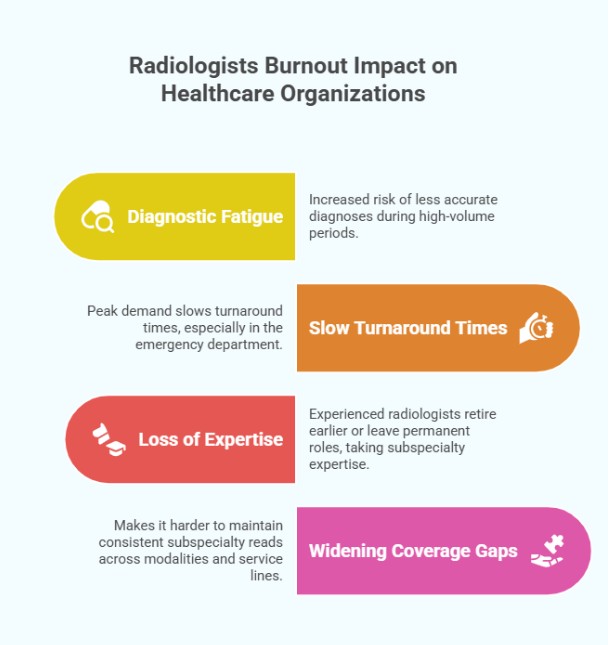
What’s the Impact of Radiologists Burnout on Healthcare Organizations?
Burnout doesn’t stay contained at the individual level. It also shows up in how your organization as a whole performs.
- Diagnostic fatigue increases, which raises the risk of less accurate diagnoses during high-volume periods.
- Turnaround times slow during peak demand, particularly in the emergency department, where speed matters most.
- Experienced radiologists retire earlier or leave permanent roles, which takes subspecialty expertise with them.
- Coverage gaps widen, which makes it harder to maintain consistent subspecialty reads across modalities and service lines.
For recruiters and HR leaders, this is a radiology working model problem. When the structure of work no longer supports sustainability, even the best compensation packages fall short.
The rest of this article examines what the research says about how to fix that, and why flexibility is becoming one of the most powerful tools healthcare organizations have to protect both their radiologists and their radiology services.
What the Latest Research Says About Remote & Flexible Radiology Work
If you want to understand how evolving radiology working models impact clinician satisfaction and retention, you should pay close attention to emerging evidence, typically from the field’s own literature.
A recent study, “Current Trends in Remote and Flexible Work Options in Radiology and Perception of Impact on Radiologist Well-being,” published in ScienceDirect, directly examined how remote and flexible work options affect radiologist well‑being and employment preferences. The study offers insights that go beyond anecdote and into measurable trends.
Overview of the Academic Radiology Study
Let’s break down what we learned from the study and what this means for radiologists and the people hiring them.
Study Objective and Population
In April 2024, 981 radiologists were invited to participate, and 205 completed the anonymous survey. This gives us a robust snapshot of attitudes across career stages and settings.
Scope of Work Models Analyzed
Respondents reported on their participation in different work models, including fully remote, hybrid (a mix of remote and on‑site), and traditional on‑site schedules. The survey captured both availability and participation rates, revealing that:
- 91.8% of institutions offered remote work options,
- 73% of respondents actively participated in remote workflows, and
- 79% preferred hybrid arrangements combining on‑site and remote responsibilities
- 46.4% had access to flexible scheduling options.
Key Well‑Being and Burnout Metrics Measured
The study didn’t stop at counting participation, either. It also explored perceived impact. Radiologists reported whether remote and flexible scheduling options influenced their:
- Work‑life balance,
- Overall well‑being
- Commute time burden
- Importance of flexibility in job choice decisions.
Key Findings of the Study
Among participants, 89% of those working remotely and 91% of those with flexible schedules reported improvements in well‑being tied to these models.
On top of that, 68-70% said that remote and flexible options were important factors in their career decisions. This suggests that these work models can be important recruitment and retention levers.
Read Next: Remote Radiology: Solving Staffing, Speed, and Quality Challenges
Why Does This Study Matter to Healthcare Leaders?
For healthcare leaders managing recruitment, retention, and coverage strategy, the implications of this study are loud and clear: flexibility is now a key part of hiring.
The high adoption and strong preference for hybrid and remote models are signs of a fundamental shift in how radiologists want to work. Healthcare organizations that ignore this trend risk falling behind in the talent race.
More importantly, this study puts hard data behind what many HR teams are already seeing anecdotally. Remote and flexible work models tangibly improve well-being, and well-being is a powerful predictor of long-term retention, performance, and productivity.
Another standout insight for healthcare leadership: flexibility matters most to the very segments of the workforce you're struggling hardest to recruit and keep. This means early- and mid-career professionals, and women radiologists prefer work-life balance.
And finally, this is all happening right now, and fast. If your facility still treats remote radiology as an exception or a backup plan, you’re competing with organizations that have made it central to their radiology working model and are already reaping the benefits.
In other words, flexible radiology staffing helps you secure access to talent, protect your operations, and preserve the quality of diagnoses.
Why Flexibility Directly Impacts Radiologist Retention
Based on our experience working with different teams, we have found that retention isn’t solely about pay. Compensation absolutely matters, but the structure of work itself is increasingly what keeps clinicians in their roles long‑term.
Multiple workforce studies show that burnout and poor work‑life integration are major predictors of intent to leave, even when compensation is competitive.
For example, a large cross‑sectional study of nearly 19,000 academic physicians found that more than 32% reported a moderate or greater intention to leave their current job within two years. And that this “intent to leave” was strongly linked to burnout and lack of professional fulfillment.
In other words, you shouldn’t be treating flexibility merely as a perk. It’s directly tied to how clinicians experience their day‑to‑day work, and that experience translates into career decisions.
Schedule and Location as a Primary Radiologist's Retention Lever
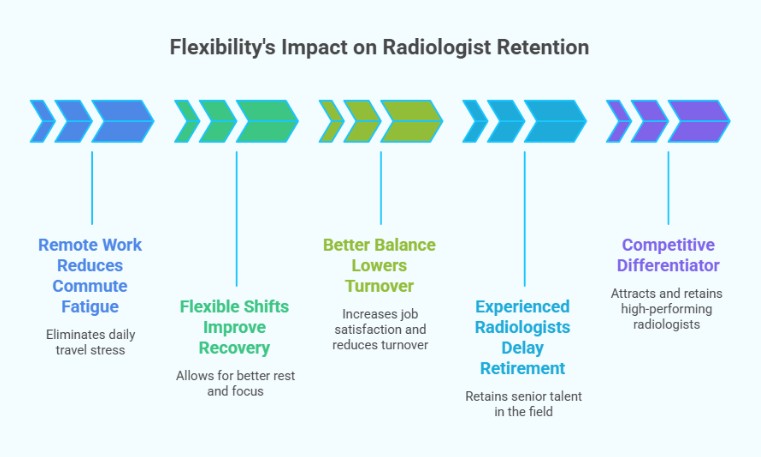
Here’s why flexibility matters so much:
- Remote work reduces commute‑related fatigue: Even modest daily travel adds up to hours of lost rest and personal time each week
- Flexible shifts improve recovery and focus: Radiologists with schedule autonomy can plan blocks of on‑site work around remote blocks, which supports sustainable energy and concentration during imaging interpretation
- Better balance lowers turnover risk: Clinicians with more control over when and where they work are less likely to actively look for new positions
- Experienced radiologists delay retirement when flexibility exists: Senior talent often wants to scale down or alter their hours rather than exit the field entirely, and flexibility makes that possible
In the context of tight labor markets and growing demand for radiology services, from CT scans and chest X‑rays to advanced medical image analysis, offering flexible work models is now a competitive differentiator when recruiting and retaining high‑performing radiologists.
The Link Between Well-Being, Burnout, and the Radiologist Shortage
Remember that burnout is directly tied to the workforce shortages healthcare leaders are facing right now. It’s a vicious cycle where staff leave because they’re overwhelmed, and the resulting gaps make workloads heavier for those who remain. This means burnout is a strategic workforce challenge with real consequences for facilities.
Burnout is a major driver of staffing declines and turnover. A shortage of 42,000 radiologists is expected by 2033, and burnout is a major factor in this.
For radiology departments in particular, this manifests in three key ways:
- Facilities are competing for a shrinking talent pool. As burnout rises, more clinicians reduce hours, pursue part‑time roles, or leave clinical practice entirely, which shrinks the pool of available radiologists.
- Traditional full‑time, on‑site models limit hiring reach. Rigid schedules and fixed locations narrow the recruiting catchment. This forces teams to vie for a small set of candidates who are willing to work under outdated paradigms.
- Burnout perpetuates shortages in a feedback loop. As teams erode, the stress and workload on remaining clinicians escalate, which in turn fuels more turnover.
This is precisely why modern workforce strategy is shifting toward flexible radiology work models like remote and hybrid radiology. These models provide alternatives that broaden your talent pipeline, reduce the stress that comes with inflexible schedules, and support sustainable careers.
In the next section, we’ll explore how teleradiology in particular can serve as a solution if you want to outperform traditional staffing approaches and build resilience into your radiology services.
Teleradiology as a Long-Term Staffing Strategy
As HR leaders rethink how to build resilient, future‑ready radiology teams, teleradiology is emerging as a long‑term staffing strategy.
Unlike traditional models that tether radiologists to onsite duties, teleradiology allows clinicians to interpret radiological images like CT scans and chest X‑rays remotely. This means you can widen your talent pool and reach without sacrificing diagnostic quality or patient care.
You can explore the basics in our article here: What Is Teleradiology.
The Everlight Radiology, Global Radiologist Report 2025, shows widespread recognition of this shift. Nearly 98% of healthcare organizations reported that outsourcing to teleradiology delivers measurable benefits.
Read Next: Teleradiology Trends and Industry Changes
How Teleradiology Supports Sustainable Workforce Models
Now, let's explore why teleradiology has become such a practical staffing option.
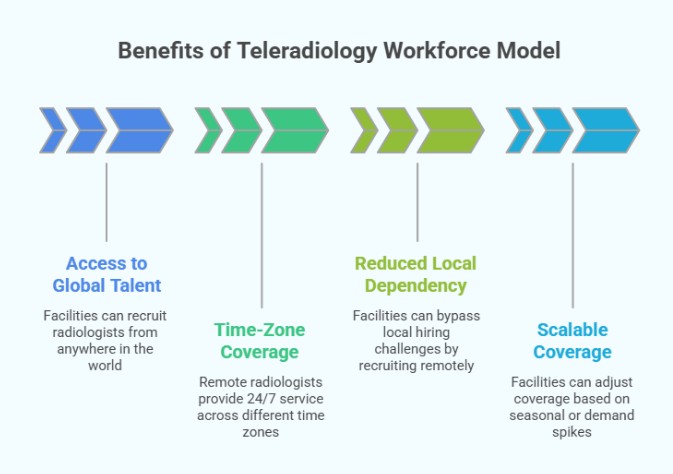
Access to national and global radiologist talent pools
With teleradiology, facilities are no longer confined to local labor markets. You can recruit based on expertise and fit, whether that’s neuro, MSK, body imaging, or emergency department reads. This significantly widens the candidate pool.
Time‑zone‑based coverage without overloading local teams
Remote radiologists can provide reads across time zones, so you get true 24/7 service without burning out your on‑site staff. This is particularly valuable for peak imaging hours or emergency care where turnaround times matter most.
Reduced dependency on hard‑to‑hire local markets
In regions where radiologist recruitment is historically difficult, teleradiology lets you tap into clinicians who aren’t geographically constrained and bypass competitive local hiring pressures.
Scalable coverage during seasonal or demand spikes
Whether it's seasonal imaging surges or holiday coverage, teleradiology lets you scale up and down without the long lead times and overhead of traditional hiring.
Together, these advantages make teleradiology a powerful workforce framework that supports clinician satisfaction and your organization’s performance. This matters more than ever as imaging demand grows and competition for talent intensifies.
Interested in hiring teleradiologists? Check out our article where we break down the top teleradiology recruiting partners.
What Today’s Radiologists Expect From Modern Working Models
Compensation still matters to radiologists, but how and where work happens is now equally, if not more, important.
According to a recent Medscape report, about 60% of radiologists said they would accept lower pay in exchange for a better work‑life balance, with many citing personal and family time as highly important to their overall happiness.
To meet these evolving expectations, healthcare organizations need to rethink their radiology working model. You need to focus less on rigid schedules and more on flexibility, balance, and role alignment.
Hybrid On‑Site and Remote Schedules
Hybrid work has become a baseline expectation for a lot of radiologists. Radiologists want a mix of:
- On‑site collaboration for procedures, conferences, and teamwork
- Remote interpretation of medical images and report generation when physical presence isn’t necessary
This model maintains a clinical connection while reducing commute‑related stress and giving your staff greater control over their workdays.
Flexible Night/Weekend Coverage
Traditional night and weekend shifts are a major factor in burnout and turnover. Modern models use remote radiologists and distributed schedules to guarantee coverage without piling all the burden onto any one clinician.
Reimagining after‑hours coverage this way supports well‑being and operational reliability, which is a topic we explore further here: How Teleradiology Solves Night/Weekend Coverage.
Subspecialty‑Focused Remote Assignments
Today’s radiologists want to use their training and expertise where it matters most. Flexible models make it possible to:
- Assign neuroradiology, MSK, or body imaging reads to specialists regardless of location
- Improve diagnostic accuracy by matching cases to the right eyes
- Keep clinicians engaged by reducing “task drift” into areas outside their passion or training
Structures that support subspecialty remote assignments send a powerful message: we value your expertise, and we’ll help you apply it where it counts.
When to Consider Teleradiology for Your Organization
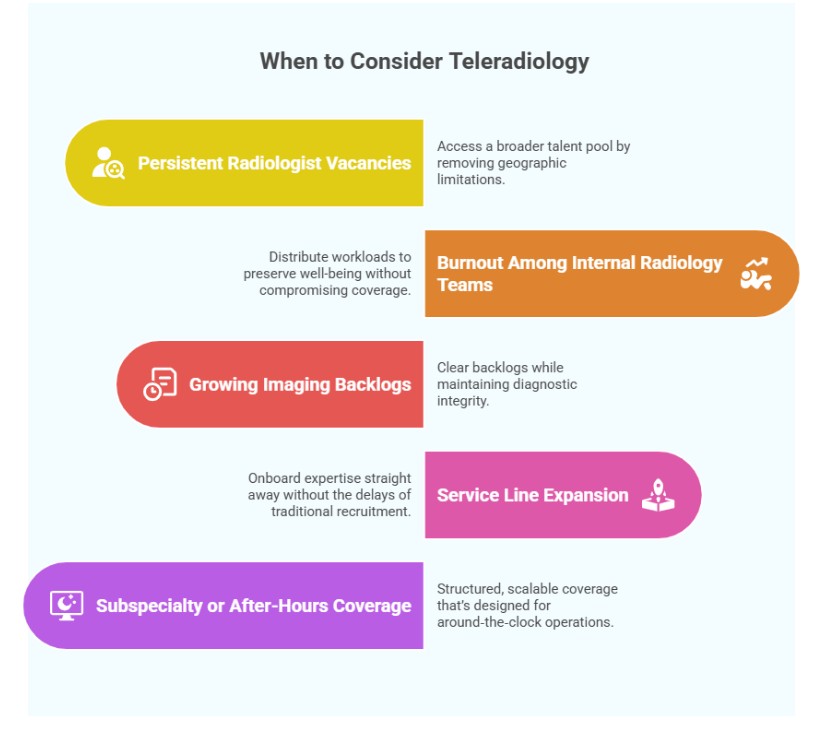
Knowing when to use teleradiology is just as important as knowing why it works. Rather than seeing it as a reactive patch for scheduling headaches, forward‑thinking healthcare leaders use teleradiology as a proactive workforce strategy that improves capacity, quality, and resilience.
Here are practical, real‑world scenarios where teleradiology becomes necessary.
Persistent Radiologist Vacancies
If your facility struggles to fill radiologist openings, particularly in subspecialty areas like neuroradiology or pediatric imaging, teleradiology gives you access to a broader talent pool. We have seen that by removing geographic limitations, you can match the right clinician to your needs faster, without waiting for a local hire who may never materialize.
Burnout Among Internal Radiology Teams
If your leadership is tracking burnout flags like high turnover, frequent sick days, or clinicians reducing hours, it’s a sign that you need to change the way workloads are designed.
Teleradiology offers scheduling alternatives that help distribute night, weekend, and after‑hours work in ways that preserve well‑being without compromising coverage.
Growing Imaging Backlogs and Delayed Reads
Backlogs in reporting are a concrete signal of capacity strain, not just staffing fluctuation. A survey across global radiology practices found that up to 68% of facilities had unreported imaging examinations. This shows how much demand for interpretation often outpaces reporting capacity.
We have observed that when backlogs are this common, relying solely on internal hires, who may already be overextended, only further slows turnaround times. Teleradiology helps clear backlogs while maintaining diagnostic integrity.
Service Line Expansion Without Local Talent Availability
Planning to expand imaging services like introducing new CT protocols, advanced medical image analysis platforms, or specialized reads, but don’t have the local expertise on staff? Teleradiology allows for subspecialty‑focused remote assignments so you can onboard expertise straight away without the delays of traditional recruitment cycles.
Need for Subspecialty or After‑Hours Coverage
Many facilities resort to overtime, locums, or stretched on‑site rotations to cover nights and weekends, all of which can drive burnout and cost. Teleradiology gives you structured, scalable coverage that’s designed for around‑the‑clock operations but doesn’t exhaust your core team.
How AAG Health Can Help You Hire a Teleradiologist
At a time when radiology departments are facing mounting pressure from staffing gaps, growing imaging demand, and clinician burnout, AAG Health delivers a smarter way forward.
As a national leader in healthcare staffing and an active member of the American Staffing Association, we bring together data-driven sourcing, flexible engagement models, and high-touch client support to help facilities build radiology teams that last.
Here’s how we do it:
- Access to pre-vetted, licensed radiologists: Every provider in our network is thoroughly credentialed and ready to work, which saves you weeks (or months) in hiring time
- Subspecialty matching across modalities: From neuro and MSK to body and emergency imaging, we match clinicians to the exact diagnostic needs of your facility
- Flexible engagement models: Whether you need part-time coverage, full-time remote reads, or weekend-only shifts, we make sure the staffing structure meets your goals
- Rapid deployment timelines: Our proprietary platform drives over 400 daily candidate inquiries, so we can place radiologists in as little as 55-90 days, well below the national average
Facilities that partner with AAG Health get continuity, cultural fit, and long-term value. With burnout on the rise and the radiologist shortage deepening, your working model can be your biggest competitive advantage, but only if it’s designed to support flexibility, balance, and clinical excellence.
Ready to bring high-quality teleradiology staffing to your organization? Get in touch with us to explore how we can help you attract, hire, and retain the radiology talent you need.
FAQs
What are the main benefits of remote or hybrid radiology roles for healthcare facilities?
Remote and hybrid radiology roles give you access to a wider talent pool, including subspecialists who may not be available locally. These models help maintain consistent coverage across nights, weekends, and peak imaging hours without overloading on-site teams.
They also support better retention by improving work-life balance for radiologists, which reduces turnover and stabilizes staffing.
Does remote work affect diagnostic accuracy or turnaround times?
Remote work does not negatively affect diagnostic accuracy or turnaround times when radiologists are supported by reliable platforms, structured data, and well-designed workflows. With the right systems in place, remote radiologists can deliver timely reads and maintain consistent quality.
What challenges do facilities face when implementing teleradiology?
Facilities usually face challenges around credentialing timelines, technology integration, and coordination between on-site and remote teams. However, working with an experienced teleradiology recruitment partner like AAG Healthcan simplify these steps and help teams get coverage in place without unnecessary delays.
How does AAG Health match radiologists with the right remote or hybrid opportunities?
We use smart, data-driven matching to align each radiologist’s skills and preferences with roles that fit, backed by insights from AI systems and medical data.
What makes AAG Health different from other teleradiology staffing providers?
AAG Health combines faster placement, cultural alignment, and strategic use of AI, while also contributing to radiology education and workforce development for medical students.
How quickly can AAG Health help us fill a radiology position?
Most placements happen in 55-90 days thanks to our large talent pipeline and hands-on support team that accelerates onboarding.
