
Healthcare facilities are facing persistent staffing shortages that show no sign of easing. A recent McKinsey report estimates a global shortage of at least 10 million healthcare workers by 2030, a gap that affects patient care and operational stability across clinical settings.
These challenges intensify during holiday periods. Full-time staff request time off, while patient volume mostly remains steady or increases, particularly due to seasonal illnesses like the flu.
Internal teams usually take on extra workload, which leads to fatigue and burnout. That stress can ripple through departments and increase the risk of errors, longer wait times in emergency departments, and uneven continuity of care.
This is where locum tenens staffing becomes essential. They give you a reliable way to plan holiday coverage without overburdening your core workforce.
What is locum tenens?
In healthcare, locum tenens refers to clinicians who work in temporary roles to cover staffing gaps at hospitals, clinics, and medical practices.
These professionals could be physicians, nurses, advanced practice providers, radiologists, pediatricians, or other clinicians stepping in when full-time staff are on leave, when patient volume rises, or when positions remain open during a lengthy recruitment process.
Locum tenens assignments can last a few days, several weeks, or even months, depending on a facility’s needs and the role being filled. This kind of temporary staffing has become a core workforce strategy for healthcare organizations.
Short-term assignments like these help healthcare facilities manage planned absences, address sudden staffing shortages, and maintain continuity of patient care. Locum staffing also gives medical professionals greater flexibility in their careers and a better work-life balance than many traditional employment paths.
This YouTube video breaks down what locum tenens is in more detail:
How locum tenens providers address holiday staffing shortages
Holiday staffing gaps show up as empty shifts, higher patient-to-staff ratios, and mounting pressure on full-time staff already stretched thin. That pressure comes against the backdrop of a broader workforce shortfall. It was estimated that by 2025, the U.S. could face a shortage of between 200,000 and 450,000 nurses needed for direct patient care, a gap that directly affects patient care capacity and continuity.
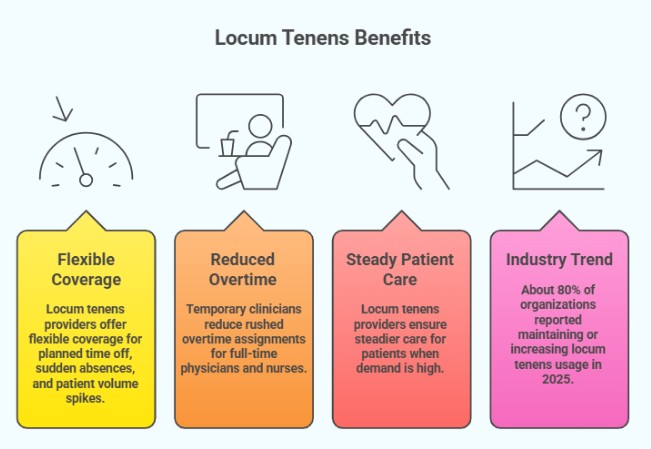
Locum tenens providers offer a flexible solution to these predictable gaps. By bringing in temporary clinicians during holidays, planned time off, or flu season, you can avoid overburdening your permanent staff with rushed overtime. This helps maintain steady care for patients, even when demand spikes.
As reflected in recent industry data, roughly 80% of facilities reported maintaining or increasing locum tenens usage in 2025, exceeding earlier forecasts. This is a clear sign that many leaders see this approach working for both staffing gaps and overall workforce planning.
Why Locum Tenens Providers are Best to Address Holiday Staffing Shortages: 6 Major Reasons
Now, we’ll dive into the six key reasons why locum tenens is the best approach for managing holiday staffing shortages.
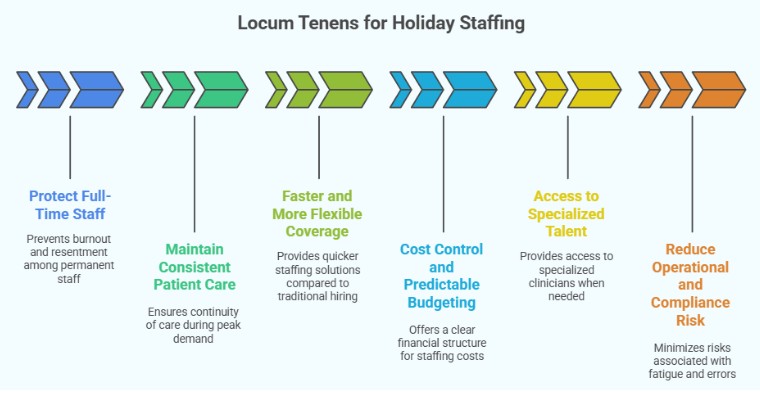
Reason #1: Protect full-time staff from burnout and resentment
Holiday coverage mostly falls on the same people year after year. It means extra shifts, fewer days off, and less recovery time. And over time, that pattern wears down even the most committed teams.
A McKinsey survey found that nearly half of frontline healthcare workers report feeling burned out, with workload and lack of schedule control among the top drivers. Burnout at that level doesn’t stay contained. It shows up as disengagement, higher turnover risk, and gaps in continuity of care.
Locum tenens providers give healthcare facilities a practical alternative. Planned holiday coverage allows full-time physicians, nurses, and advanced practice providers to step away without guilt or disruption.
This allows your teams to return rested instead of resentful, and patient care stays consistent instead of stretched thin. As many organizations have seen, short-term staffing support usually costs far less than the long-term impact of burnout, turnover, and recruitment costs post-holidays.
Partners like AAG Health focus on sustainable coverage models that protect work-life balance while keeping operations steady during high-pressure periods.
Reason #2: Maintain consistent patient care during peak demand
Patient care rarely slows down during the holidays. In many medical centers, demand actually rises as seasonal illnesses, weather-related injuries, and delayed care all converge.
This surge becomes even more challenging when your teams are already short-staffed. In fact, 35% of healthcare organizations use locum tenens specifically to meet rising patient demand, while another 28% bring in locum providers to supplement staff during peak periods.
Locum tenens providers help healthcare facilities keep staffing levels in line with patient volume. Rather than overburdening your full-time staff, you can bring in experienced medical professionals who are accustomed to stepping into active clinical settings.
With appropriate orientation and access to the electronic health record, locums support continuity of care and help teams keep pace when demand spikes.
Reason #3: Faster and more flexible coverage than traditional hiring
Permanent hiring mostly doesn't align with the quick turnaround needed during holiday periods. Here’s why:
- Physician and advanced practice roles require years of medical school, clinical training, and state licensure before clinicians can practice. This makes the hiring process slow and challenging.
- Extensive credentialing is necessary before clinicians can begin working in clinical settings.
- Recruitment and onboarding processes can take several months, even after positions have been approved. In fact, the average hospital recruitment team takes about 222 days (over 7 months) to fill an open physician position through in-house hiring.
Holiday staffing gaps, however, usually arise just a few weeks in advance, which makes traditional recruitment timelines nearly impossible to meet.
Locum tenens providers offer a much faster and more flexible solution. Here’s how:
- Credentialing and malpractice insurance are handled by staffing agencies upfront, ensuring no additional delays.
- Assignment logistics are managed externally, reducing the administrative burden on your HR and recruitment teams.
- Short-term locum assignments provide healthcare facilities with the flexibility to secure coverage when needed most, without the pressure of making rushed permanent decisions or overburdening full-time staff.
Reason #4: Cost control and predictable budgeting
Holiday staffing gaps often drive costs that are hard to forecast. Overtime, premium shifts, and short-term coverage decisions can push labor spending higher in a matter of weeks. The American Hospital Association (AHA) reports that labor expenses make up a large part (56%) of hospital operating costs. When staffing decisions stay reactive, this makes it harder to make budget predictions.
Locum tenens providers offer a clearer financial structure during holiday periods. Rates are agreed to in advance, malpractice insurance is typically included, and there are no added obligations tied to benefits, health insurance, or long-term employment.
This structure gives healthcare facilities more control over staffing costs while avoiding the compounding expense of overtime and last-minute scheduling changes.
Reason #5: Access to specialized talent when you need it most
Holiday coverage becomes significantly more complicated when specialty roles are involved, particularly in high-acuity clinical settings. Roles like radiology, emergency medicine, anesthesia, and critical care require clinicians who can step in with minimal orientation and quickly integrate into your team.
When coverage gaps occur in these specialized roles, it can lead to interruptions in service lines, delays in diagnosis, or even treatment setbacks.
Smaller hospitals and rural medical centers mostly feel the effects of these gaps more acutely, as a single absence can disrupt multiple departments and negatively impact patient care.
In these situations, locum tenens providers offer a reliable solution. By bringing in temporary specialists, you can expand your access to talent beyond just local or regional networks. These short-term assignments allow facilities to support patient populations without the need for long-term staffing changes.
Furthermore, planned coverage during the holidays ensures that gaps in specialized care are filled, reducing delays when specialist availability is typically limited.
Reason #6: Reduce operational and compliance risk during holidays
Holiday staffing pressure shows up first as fatigue. Longer shifts, fewer recovery days, and thinner coverage increase the likelihood of documentation errors, missed handoffs, and clinical mistakes.
The Centers for Disease Control and Prevention notes that fatigue among healthcare workers is linked to reduced performance, slower reaction times, and impaired judgment, all of which can affect patient safety and regulatory compliance. These risks rise when staffing plans rely too heavily on overtime instead of planned coverage.
Locum tenens providers help healthcare facilities spread workload more evenly during high-risk periods. Planned coverage reduces reliance on a small group of clinicians and lowers exposure tied to single-point-of-failure staffing models. This stability supports safer operations across emergency departments, inpatient units, and specialty services.
How to successfully use locum tenens for holiday coverage
Holiday coverage works best when it’s planned, coordinated, and treated as part of normal operations instead of a last-minute fix.
Seasonal demand patterns are well-documented in the world of healthcare. The CDC reports that flu season alone results in between 120,000 and 710,000 medical visits each year in the U.S. This surge places predictable strain on emergency departments and inpatient units during late fall and winter. Given the added pressure, proactive staffing decisions become crucial.
Here’s how to use locums to your advantage.
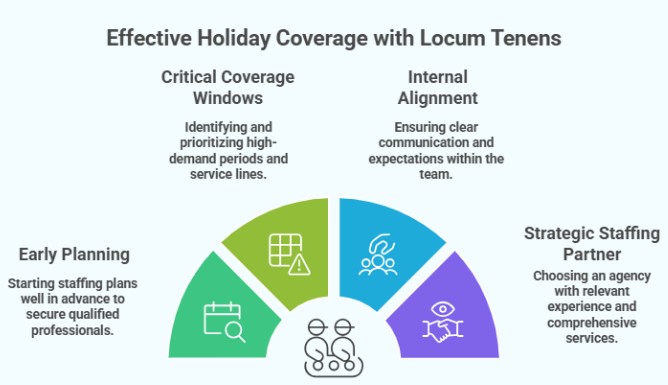
1. Start planning earlier than you think
Holiday staffing pressures rarely come as a surprise. Year after year, PTO requests tend to cluster around the same dates, and flu season, along with winter weather, drives an increase in patient volume.
As per our experience, credentialing and scheduling still take time, even for short-term assignments. That’s why early planning is key.
We strongly recommend starting your staffing plans sooner rather than later. By doing so, you’ll have access to a broader pool of qualified medical professionals, which allows you to make more informed, flexible decisions.
This proactive approach helps reduce the risk of making rushed decisions that may limit the fit or flexibility of your locum providers.
2. Identify critical coverage windows
Not every shift carries the same level of operational risk, so it’s important to prioritize your staffing needs effectively. Based on our experience, here’s how we recommend you approach it:
- Review historical data to pinpoint periods with the highest patient volume, this will help you anticipate demand.
- Identify service lines where a single absence can disrupt care delivery
- Pay close attention to emergency departments, radiology coverage, and specialty services
By establishing clear priorities, you’ll enable staffing agencies to focus on the roles that matter most, ensuring critical areas are always covered.
3. Get clear internally on expectations and handoffs
Locum tenens coverage runs much smoother when your internal teams are fully aligned before clinicians arrive. From our experience, we’ve found that these steps make a huge difference:
- Clarify the scope of coverage, make sure everyone is on the same page about shift structure and on-call expectations.
- Get documentation standards and electronic health record (EHR) access sorted out ahead of time. This ensures locums can get started quickly without unnecessary delays.
- Assign clear points of contact for both clinical and operational questions. Having a go-to person on each side can make all the difference when things get hectic.
When your team knows what to expect and where to go for support, it helps reduce friction during those busy periods, ensuring that everything runs smoothly. Trust us, these early conversations and prep work pay off big time when the locums step in.
4. Work with a staffing partner who understands healthcare operations
Partnering with the right staffing agency can make or break how smoothly your holiday coverage runs. Here’s what you should look for:
- Experience in similar clinical settings and with the patient populations you serve. This ensures they can meet your specific needs.
- Agencies that handle credentialing, malpractice insurance, and logistics end-to-end, so you don’t have to deal with the administrative burden.
- A partner who treats staffing as part of your overall operations, not just as a transactional placement.
For example, at AAG Health, we support healthcare facilities as a strategic advisor throughout the process. Our approach combines data-informed planning, operational awareness, and high-touch coordination to help organizations manage holiday coverage without disrupting teams or patient care.
Secure Your Locum Tenens Coverage Today With Alpha Apex Group
Holiday staffing challenges are inevitable, and so is the strain they place on both your teams and patient care. What changes year after year is how prepared your organization is when schedules tighten and patient volume rises.
Locum tenens coverage transforms these pressure points into a proactive plan, giving healthcare facilities the ability to protect full-time staff, maintain consistent care, and manage risk during high-demand periods.
Early planning opens the door to better-fit clinicians and smoother onboarding, as well as fewer last-minute compromises. It also gives you more control over cost, coverage, and operations when it matters most.
At AAG Health, we partner with healthcare facilities to design holiday staffing strategies that align with clinical needs, operational realities, and long-term goals. Whether you need short-term coverage for physicians, advanced practice providers, or specialty roles, their team supports you from planning through placement.
Get in touch to learn more about our staffing and consulting services and start building a coverage strategy that works for your organization.
FAQs
What types of healthcare professionals can be hired through locum tenens?
Healthcare facilities can hire physicians, advanced practice providers, nurses, radiologists, and other specialty clinicians through locum tenens, depending on coverage needs and clinical settings.
How far in advance should we plan holiday locum coverage?
Planning three to six months ahead offers the widest pool of available clinicians, though some roles can still be filled closer to the holiday period if needed.
Are locum tenens clinicians properly credentialed and licensed?
Yes. Locum tenens clinicians are licensed in the states where they practice and complete a full credentialing process before starting any assignment.
How long can locum tenens assignments last?
Assignments can range from a few days to several months, depending on the role, patient volume, and the facility’s coverage needs.
How does AAG Health ensure quality and fit with our facility?
AAG Health combines rigorous credentialing with role-specific vetting and an understanding of each facility’s clinical and operational needs to support strong alignment from day one.
What makes AAG Health different from other locum tenens agencies?
AAG Health takes a consultative approach. We use data, market insight, and high-touch coordination to support staffing decisions instead of treating placements as one-off transactions.
Can AAG Health help with both short-term holiday coverage and long-term staffing gaps?
Yes. We support short-term holiday coverage while also helping organizations address longer-term staffing needs through structured planning and ongoing partnerships.
