
The path to becoming a radiologist attracts more interest each year, and for good reason. Radiologists play a key role in diagnosing disease by interpreting medical images such as CT scans and MRIs, and guiding treatment and patient care behind the scenes.
With growing demand for imaging services and a shrinking specialist workforce, the career path for diagnostic radiologists offers significant opportunities.
In 2023, 37,482 radiologists treated Medicare patients. Without an expansion in residency slots, projections estimate only about 47,119 radiologists by 2055, even as imaging demand increases by 16.9% to 26.9%. For students and early-career professionals, this widening gap translates into strong long-term job opportunities.
In this article, we’ll look at the steps you need to take to become a radiologist and answer some common questions.
What is a Radiologist?
A radiologist is a licensed medical doctor who specializes in interpreting medical images, such as X‑rays, CT scans, MRIs, nuclear medicine, and ultrasounds, to diagnose and monitor disease.
Their training spans at least 13 years and includes medical school, an internship, a four-year diagnostic radiology residency, and often a fellowship in a subspecialty such as interventional or pediatric radiology. Radiologists also advise physicians on the most appropriate imaging tests and protocols for each clinical scenario.
What is the role of a radiologist?
Radiologists interpret imaging studies, prepare diagnostic reports, and guide patient management in collaboration with referring physicians. Their workday often includes consulting on complex cases and participating in multidisciplinary meetings for specialties like oncology and trauma. Many also perform minimally invasive, image-guided procedures in interventional radiology.
According to a European Society of Radiology survey, 56% of radiologists report routinely integrating imaging data with clinical and pathology information to support patient management.
What are the Sub-Specialties of Radiology?
Once you’ve decided to become a radiologist, you’ll face a major decision: which subspecialty will you pursue? Each path brings its own blend of clinical focus, procedures, and compensation (yes, radiologist salary varies significantly by subspecialty).
Let’s run through your main options here:
- Neuroradiology: Focuses on the brain, spine, head & neck imaging using MRI, CT, and angiography. It often deals with stroke, tumors, and neurologic disease.
- Musculoskeletal (MSK) Radiology: Involves imaging bones, joints, soft‑tissue injuries, and sports medicine cases. It uses advanced MRI, CT, and ultrasound.
- Pediatric Radiology: Dedicated imaging of infants, children, and adolescents. This field requires extra sensitivity to smaller anatomy, lower radiation dose protocol,s and child‑friendly workflows.
- Cardiothoracic Radiology: Imaging the heart, lungs, and chest cavity using CT, MRI, PET, and often working with cardiologists or pulmonologists.
- Abdominal/GI Radiology: Focuses on the liver, pancreas, bowel, kidneys, and GI tract, and uses techniques like CT, MRI, ultrasound, and sometimes interventional imaging.
- Interventional Radiology: A procedural subspecialty that uses image‑guided treatments such as angioplasty, embolisation, biopsies, and stent placement, often in hybrid suites.
- Breast Imaging: Mostly focusing on mammography, ultrasound, and MRI of the breast. These radiologists work closely with cancer diagnosis and screening programs.
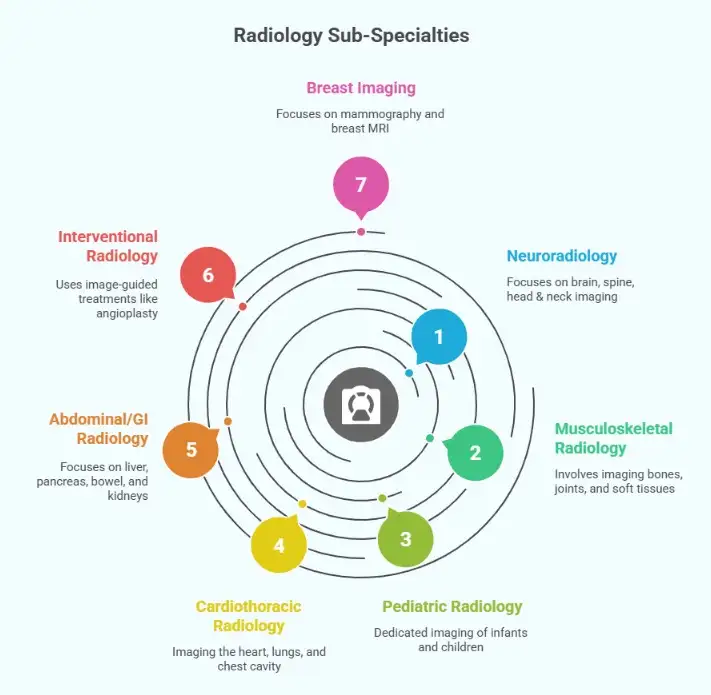
Choosing a subspecialty helps you build focused expertise and align with job markets that match your preferred workstyle.
High-procedure fields like interventional radiology and neuroradiology tend to offer higher compensation and strong demand because of their complexity and clinical involvement.
For example, MGMA’s 2023 survey found that interventional radiologists earned 10–16% more than diagnostic radiologists, even though diagnostic radiologists generated 46–53% more wRVUs. This reflects the higher procedural complexity and clinical involvement in IR.
P.S. Want a deeper breakdown? Check out our guide on the different types of radiologists and what they do.
What’s the Difference Between Radiologists and Radiographers?
If you’re exploring how to become a radiologist, it’s important to understand how the role differs from a radiographer (also called a radiologic technologist).
A radiologist is a licensed medical doctor who interprets imaging studies such as CT scans, MRIs, ultrasounds, and nuclear medicine exams. They diagnose conditions, recommend further tests, and, in some subspecialties, perform image-guided procedures.
A radiographer, in contrast, is an allied-health professional who operates imaging equipment, positions patients, ensures image quality, and captures the scans, but does not diagnose disease or decide treatment plans.
If you’re comparing the two pathways, these are the core differences:
- Education and credentials: Radiologists complete medical school and residency. Radiographers typically complete an associate’s or bachelor’s degree plus certification.
- Scope of work: Radiographers perform the imaging; radiologists analyze the images and guide patient care.
- Career trajectory: Radiologists take on physician-level responsibility and clinical decision-making, while radiographers follow a technical, imaging-focused career path.
This distinction helps you choose the route that aligns with your long-term goals, whether you prefer hands-on imaging work or the diagnostic and clinical responsibilities of a radiologist.
Why Radiology is a Promising Career
The opportunity in this field is strong. As we learned, the supply of radiologists is growing faster than imaging demand. This means the gap between demand and supply isn’t closing, which signals strong future demand for radiologist jobs.
Compensation also remains high. Radiology is among the top-earning medical specialties. According to Salary.com, the average U.S. radiologist's salary is approximately $529,190 per year, depending on subspecialty, experience, and location. Combined with strong demand, radiology provides a stable and financially rewarding career path.
While the journey to becoming a radiologist is long and involves serious training (which we’ll talk about in the next section), the payoff in terms of job security, professional influence, and salary can be huge.
How to Become a Radiologist — Step-by-Step Guide
Here’s a clear, high‑level roadmap of the journey you’ll need to take to become a radiologist.
Step 1: Undergraduate / Pre‑Med (~4 years)
You’ll start with a bachelor’s degree. While you don’t need a specific major, you’ll typically take biology, chemistry, physics, or math, and other pre‑med prerequisites. Build strong grades, complete clinical internships or volunteer in healthcare facilities, and prep for the MCAT if you’re in the U.S.
Step 2: Take the MCAT
The Medical College Admission Test (MCAT) is required for admission to nearly all medical schools in the U.S. It’s a standardized, multiple-choice exam that covers biology, biochemistry, chemistry, physics, psychology, and critical thinking. Your score plays a major role in medical school admissions, so preparing early and thoroughly is key. Competitive applicants tend to average scores of 511-515 out of 528.
Step 3: Medical School (~4 years)
Medical school includes two years of foundational coursework and two years of clinical rotations. You’ll gain hands-on exposure to fields like radiology, internal medicine, surgery, pediatrics, and emergency medicine. Rotations help you confirm your interest in radiology and build a strong residency application.
Step 4: Internship and Radiology Residency (~4 years or more)
After earning your medical degree, you’ll complete an internship and then enter a residency program in diagnostic radiology. This is where you learn to interpret medical images (CT scans, MRIs, nuclear imaging), operate imaging equipment, and understand clinical workflows.
Step 5: Optional Fellowship (1-2 years)
Want to dive deeper? You can pursue a fellowship in subspecialties like interventional radiology, pediatric radiology, or neuroradiology. This extra training improves your skillset and can significantly impact your career direction and radiologist salary.
Step 6: Licensing and Board Certification
You’ll need to pass your licensing exams (for example, USMLE) and apply for a medical license in your state. Then you’ll pursue board certification through the American Board of Radiology (ABR) or an equivalent credentialing organization. This is a must for hospital credentialing and most radiologist jobs.
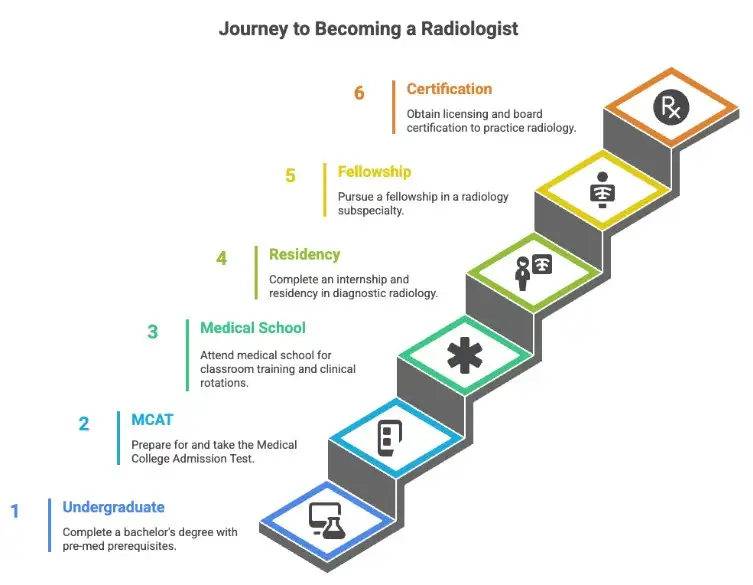
A few extra things to keep in mind:
- Choosing a subspecialty (like diagnostic vs interventional or pediatric vs adult) matters. It affects the kinds of procedures you do, your schedule, your job market, and your ultimate radiologist salary.
- Skills and traits you’ll need: strong analytical ability, comfort with medical imaging technology, collaboration with the healthcare team, ability to work under pressure, and a lifelong learning mindset.
- Timeline realism: Yes, it’s a long road. But if you’re committed, that investment opens up high‑opportunity career paths.
What is the Average Salary for Radiologists?
Radiology remains one of the highest-earning specialties in medicine, though actual income depends on factors such as subspecialty, location, work setting, and experience.
In 2025, the average radiologist's salary in the U.S. hit $571,749, according to a survey of 37,000 physicians by Doximity. This was up 7.5% from the previous year. Entry-level roles start around $292,000, while experienced radiologists can earn $600K+.
What affects a radiologist's salary?
- Subspecialty: Interventional radiologists often earn more than general diagnostic radiologists
- Location: Salaries tend to be higher in high-demand regions, but the real take-home depends on the cost of living
- Experience & Setting: Private practice usually pays more than academic roles, but comes with different responsibilities
- Extras: Call shifts, teleradiology, and locum work can add thousands annually
Read Next: Radiologist Salary by State: Which States Pay the Highest?
Here’s a breakdown of radiologist salaries by subspecialty:
- Interventional Radiology: A median of ~ $529,000/year in the U.S., with a typical range from ~$495,000 to ~$635,000
- Neuroradiology: A median of $728,000/year in the U.S., with top‑paying states exceeding $900,000
- Diagnostic Radiologist: A median of ~529,000/year in the U.S., with the highest earners making over $600,000
Career Growth & Side Perks
The radiologist career ladder typically goes like this: Junior → Subspecialist → Lead Radiologist → Director/Admin.
Along the way, perks include teaching, research, leadership roles, or even opening your own imaging center. Many radiologists supplement their income with side gigs like teleradiology or consultancy, or venture into locum work.
Job Security and Balance
Imaging demand continues to grow, but the radiologist workforce is not expanding at the same pace. This mismatch supports long-term job stability across the field. However, radiology can involve significant reading volumes, rapidly evolving technology, and night or weekend call shifts, depending on the practice environment.
How AAG Health Helps Future Radiologists Succeed
Becoming a radiologist takes serious commitment, from acing the MCAT to surviving med school, crushing residency, and finally landing the right role. Along the way, having the right support system matters. That’s where AAG Health comes in.
AAG Health is backed by national recognition through the American Staffing Association. We bring together cutting-edge sourcing tech, data-driven talent insights, and a real human connection. Our team helps aspiring and practicing radiologists with:
- Career consulting tailored to your path
- Placement support across hospitals, outpatient centers, and private groups
- Networking opportunities in the imaging and diagnostics space
- Guidance on salary trends, benefits, and long-term career growth
If you're exploring radiology as a long-term career path, it helps to stay connected with organizations that understand the field inside out.
AAG Health is a healthcare consulting, staffing, and recruiting agency that works directly with practices and hospitals looking for radiologists across multiple subspecialties. We keep track of real job trends, hiring needs, and workforce gaps, so you get a clearer picture of what the market actually looks like.
When you’re ready to start applying your radiology training in the real world, contact AAG/H and submit your credentials to receive job matches that fit your experience.
FAQs
What does the American College of Radiology recommend when staffing a Department of Radiology?
The American College of Radiology emphasizes that qualified imaging technologists and board-certified radiologists are critical for high-quality, patient-centered care in every Department of Radiology.
Why should a medical center work with a dedicated radiology staffing agency instead of a general healthcare recruiter?
A specialty agency understands the nuanced demands of medical imaging and can match imaging technologists and radiologists based on modality, volume, and EHR systems to streamline operations and improve patient outcomes.
How does AAG Health ensure physician leaders are aligned with a facility’s clinical goals?
AAG Health assesses each candidate’s experience against your modality mix, imaging study load, and department objectives to ensure seamless integration and strong leadership in your Department of Radiology.
What makes AAG Health different from other larger firms?
Unlike bulk hiring models, AAG Health’s Talent Network is built for precision. Every imaging technologist or radiologist is vetted for licensure, culture fit, and readiness to support patient-centered care from day one.
Can AAG Health support staffing for both academic medical centers and rural hospitals?
Yes. AAG Health’s data-driven sourcing platform allows us to place top-tier imaging technologists and physician leaders in diverse clinical environments, from large academic medical centers to community-based imaging departments.
