
When you’re recruiting radiologists, getting the salary right is crucial. Recent national data shows the average full-time radiologist in the U.S. earns about $526,000 per year, and radiology climbed to the No. 3 highest-paid specialty in 2025.
Because compensation varies widely by state, geography becomes a powerful lever in structuring offers. Some states pay significantly more than the national baseline, while others fall well below it.
These differences directly influence your budget, candidate expectations, and hiring strategy.
In this guide, we’ll share the national baseline for radiologist salary, the state‑by‑state variation, and the key drivers behind those differences. We’ll also explain how recruiters and HR teams can use this information to structure stronger offers.
P.S. If you’re hiring radiologists in a competitive market, AAG Health can help you secure qualified talent fast. Our team connects hospitals and imaging centers with experienced, board-certified radiologists across all subspecialties. Reach out today to build a staffing plan that keeps your department fully supported.
National Baseline: What’s the typical radiologist's salary in the U.S?
As we have mentioned above, the average full‑time radiologist in the U.S. earns roughly $526,000 annually. This figure covers base salary, hourly equivalents, and many compensation models, though actual pay shifts based on region, experience, subspecialty, and practice setting.
Mean vs. Median and Why Recruiters Should Care
The mean reflects the overall average, but it can be pulled upward by high-earning subspecialties such as interventional radiology or large private-practice groups.
The median represents the midpoint and gives a steadier benchmark for setting salary bands. Using the median helps recruiters avoid overestimating candidate expectations or underbudgeting for competitive offers.
Entry Level, Senior Level & Total Compensation
While $526K is the headline number, the range is wide.
For example, data from Salary.com shows entry‑level radiologists may earn closer to ~$470,900 while 90th‑percentile earners approach ~$634,600 annually.
Salary Expert, meanwhile, estimates entry‑level at ~$292,558 and senior radiologists (8+ years) at ~$614,282 when broken down by base salary alone.

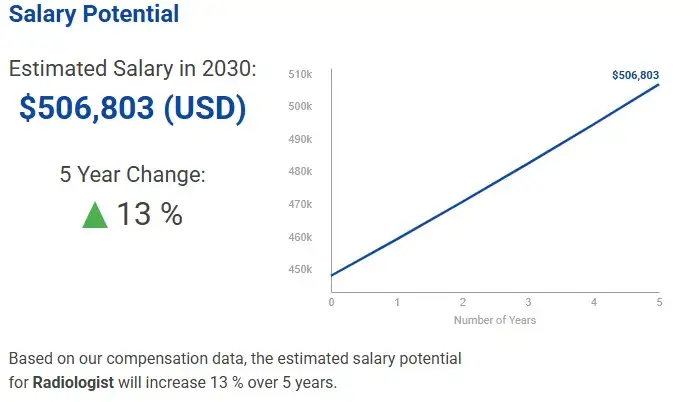
Salary growth is also strong. According to long-term projections, radiologists may see an estimated 13 percent increase over the next five years, reaching an expected salary of ~$506,803 by 2030. This reinforces radiology’s position as one of the highest-earning medical specialties.
Remember that compensation isn’t just the base salary. For radiology professionals, total compensation often includes:
- Base salary, the fixed part of the package
- Bonuses/incentives tied to productivity, locum tenens coverage, sign‑on bonuses, or subspecialty pay (like interventional radiology and nuclear medicine)
- Benefits and other perks like call schedule premiums, remote work allowance (especially for teleradiology), private practice buy‑in opportunities, academic radiologists' roles, etc.
From a recruitment viewpoint, you should consider the annual wages figure across all components, not just base salary, to stay competitive.
Why This Matters for Recruiters
Having a clear national baseline means you can benchmark your offer. A candidate in a typical metro might expect something around the median, while a senior candidate in high‑cost states or with niche subspecialties should aim higher.
You must align your contract or hiring strategy with current market compensation trends and negotiate intelligently with candidates.
P.S. Thinking about how much radiologists truly cost your organization? Our full breakdown, “The Real Cost of Radiology: What Clinics Need to Know About Radiologist Salaries in 2025,” explains the complete compensation picture and how to budget effectively.
Factors That Drive Radiologist Salary Differences by State
When it comes to a radiologist’s compensation, the state you’re hiring in has a major impact on pay. Whether you’re staffing a metropolitan hospital, a rural imaging center, or a hybrid/remote reading model, understanding state-by-state variation helps you set competitive budgets and secure top candidates.
Several factors drive the geographic spread in radiologist salaries:
- Cost of living and regional pay scales: States with high living costs and tight talent supply often pay more
- Demand and supply: If a region has few radiologists (especially subspecialists like interventional radiology or nuclear medicine), you’ll see premiums
- Subspecialty presence and advanced imaging techniques: High‑volume tertiary centres (with MRI, CT, cardiovascular magnetic resonance) push salaries up
- Practice type and staffing models: Compensation varies by private practice vs academic roles, employed vs contractor models, and fixed salary vs productivity-based structures.
- Temporary and remote coverage needs: States that depend heavily on locum tenens or teleradiology reading may offer higher pay to attract talent or cover after-hours needs.
For recruiters, this means you can’t just grab a national average radiologist salary and call it a day. You’ll want to adjust for your state’s market, practice type, and candidate’s subspecialty.

Radiologist Salaries by State 2025: A Detailed Breakdown
Here’s the average radiologist salary by state data compiled by Medality. Their dataset pulls from multiple trusted sources, including the U.S. Bureau of Labor Statistics, Medscape’s Compensation Report, and real-time salary insights from ZipRecruiter.
This combined data provides a reliable snapshot of what radiologists earn in each state and helps you benchmark offers with confidence.
The Top 5 Highest-Paying States in 2025
These top five states offer the highest annual wages for radiology professionals in 2025. Strong medical imaging volumes and competitive hiring markets help push salaries higher. Demand for specialists in diagnostic radiology, interventional radiology, and breast imaging also plays a major role.
1. New York – $409,782 Annually ($197.01/hour)
New York pays the highest due to heavy imaging volumes in NYC and Long Island, where hospitals and private groups operate 24/7 CT, MRI, and X-ray services.
Radiologists often manage high RVU loads, which increases productivity pay. Staffing shortages in interventional radiology and nuclear medicine further push offers upward.
Many practices also pay premiums for hybrid teleradiology schedules, weekend shifts, and locum tenens coverage.
Read Next: Breaking Down Radiology Costs: How RVUs, GPCI, and Reimbursement Rates Define Practice Costs
2. Pennsylvania – $375,232 Annually ($180.40/hour)
Pennsylvania’s salary levels reflect competition between hospital networks, private practices, and academic centers. Employers frequently offer strong base salary guarantees, sign-on bonuses, and shift differentials to secure talent.
Higher wages also come from heavy demand for breast imaging, vascular/interventional skills, and advanced CT/MRI interpretation. In high-volume regions, productivity-based compensation and call-pay further raise annual earnings.
3. New Hampshire – $366,923 Annually ($176.41/hour)
Despite its smaller population, New Hampshire offers some of the highest radiologist compensation in the country. Higher pay is partially tied to recruiting challenges in nonmetropolitan areas, which often rely on Diagnostic and Interventional Radiology specialists to manage broad imaging needs.
Practices may also offer additional productivity pay or hybrid on-site/remote radiology schedules to attract board-certified radiologists.
4. New Jersey – $361,359 Annually ($173.73/hour)
Radiologists in New Jersey benefit from strong regional competition, high patient throughput, and proximity to major medical groups in the Northeast. Compensation often includes a mix of base salary, productivity pay, and bonuses linked to imaging volume.
Subspecialists in areas such as nuclear medicine, cardiovascular MRI, and minimally invasive procedures generally command higher offers.
5. Wyoming – $357,458 Annually ($171.86/hour)
Wyoming offers elevated pay to overcome recruiting challenges in remote regions. Employers typically add premiums for night, weekend, and holiday shifts. Radiologists often cover broader imaging responsibilities, including trauma imaging, MRI, CT, and emergency reads, which increases compensation.
Locum tenens demand is strong, and many groups raise offers to secure full-time radiologists willing to work flexible or multi-site schedules.
How Recruiters Can Set Competitive Radiologist Salary Offers
When you’re recruiting a radiologist, you need to turn salary data into an offer strategy. The strongest approach works in three layers: the national baseline, the state premium, and the subspecialty or experience premium.
This structure helps you build offers that match the market and close candidates quickly.
1. Build Clear Offer Bands
Start with the national median or average radiologist salary as your reference point. Then adjust upward based on:
- State premium: High-cost or high-demand states mostly require 10–30% above the baseline. Some markets may require even more if imaging volume or competition is unusually high.
- Subspecialty & experience premium: Candidates trained in interventional radiology, nuclear medicine, breast imaging, or leadership roles command higher pay. Senior radiologists or those with high RVU potential should also be placed above the base rate.
Read Next: Different Types of Radiologists: A Clear Breakdown of Each Specialty
2. Avoid Under-Budgeting
It’s the fastest way to lose candidates. Top radiologists quickly recognize when an offer is below market. If your offer is not competitive, candidates will move to another state or employer offering:
- Higher base salary
- Stronger productivity pay
- Better sign-on bonuses
- More flexibility, such as remote reading or hybrid schedules
Think about the full compensation package, including base, hourly models (if used), RVU/productivity bonuses, imaging-volume bonuses, call pay, remote allowances, relocation support, and total net income. Radiologists evaluate the complete picture, instead of just the base number.
3. Key Actions HR Teams Should Take
To build offers that land, HR teams should focus on three areas:
- Review cost-of-living data using sources like HUD, the MIT Living Wage Calculator, and the Bureau of Economic Analysis to understand how state-level expenses impact salary expectations.
- Account for candidate mobility by offering higher salary bands, remote or hybrid reading options, or stronger sign-on bonuses when recruiting in rural or less competitive locations.
- Evaluate the full compensation package, including call schedules, tele-reading flexibility, relocation support, CME allowances, workstation quality, and retention or sign-on incentives. Each component shapes how radiologists perceive value.
How a Specialist Radiologists Recruiting Firm Adds Value
A staffing partner like AAG Health gives you an advantage in a competitive radiology market. The right firm offers:
- Market intelligence on radiologist salary by state, practice type, and subspecialty
- Candidate flow from multiple sourcing channels, reducing time-to-hire
- Negotiation support so you’re not working in the dark
- Locum tenens and teleradiology coverage while permanent hiring continues, ensuring patient services remain uninterrupted
This allows you to keep imaging operations fully staffed while securing the best long-term hires.
Challenges and Emerging Trends in Radiologist Compensation
Radiologist compensation is shifting rapidly. Here are the key trends recruiters and HR teams should watch as they plan salaries, benefits, and staffing strategies.
1. Remote Work and Teleradiology Are Reshaping Pay
The demand for remote radiology services is growing quickly. The global teleradiology market reached US $15.6 billion in 2024 and is projected to hit US $60.3 billion by 2030, with a strong CAGR of ~25.7%. North America alone accounts for 38.5% of that market, showing how deeply this trend affects U.S. compensation.
How this impacts salaries:
- Radiologists now compare local offers to nationwide teleradiology opportunities.
- Even on-site roles must include some flexibility to remain competitive.
- A candidate living in a lower-pay state can now read for a high-pay state, which shifts salary baselines everywhere.
The more remote reading becomes normalized, the more compensation expectations go up, especially for high-demand subspecialties.
Read Next: Teleradiology Trends and Industry Changes: A Deep Dive for 2025
2. Locum Tenens Demand Is Driving Premium Pay
Imaging demand keeps growing, but radiologist supply isn’t keeping up. Imaging volumes are projected to rise 3–4% per year, yet radiologist numbers remain constrained due to retirements and slow trainee growth. Subspecialties like interventional radiology, breast imaging, and nuclear medicine face some of the steepest shortages.
Because of this mismatch, locum tenens rates climb quickly during staffing gaps, especially in rural or high-demand regions. Premiums increase for:
- Night and weekend call
- Remote teleradiology coverage
- Subspecialty shortages (IR, nuclear medicine, breast imaging)
P.S. AAG Health gives facilities flexibility to manage these spikes with access to vetted locums, market intelligence, and fast-placement options when supply tightens.
3. Burnout and Workload Pressure Are Influencing Compensation
Radiologists' burnout is a major factor affecting compensation strategies. Recent industry data shows 44% of male radiologists and 65% of female radiologists report feeling burned out or depressed. Rising imaging volumes, particularly in MRI, CT, and nuclear medicine, combined with leaner teams, are amplifying workload pressure.
To retain talent, many organizations now offer:
- Higher overall compensation
- Remote or hybrid reading schedules
- Reduced call burden
- Shift-premium pay
- Greater schedule flexibility
4. Reimbursement and Regulatory Shifts Are Changing Pay Models
As healthcare moves toward value-based care and more cost-effective imaging, compensation structures are evolving. High-end imaging programs, such as cardiovascular MRI and advanced diagnostic radiology, may offer higher salaries but usually require:
- Strong productivity performance
- Quality or turnaround expectations
- Efficiency with advanced imaging techniques
HR teams need to align offers with expectations around imaging volume, productivity pay, remote/onsite hybrid duties, and use of advanced modalities.

Secure Top Radiology Talent With AAG Health
Radiologist salaries are rising across the country, and not evenly. Top-paying states now offer 10–30% above the national baseline, and recruiters who don’t account for these differences risk losing strong candidates fast.
To hire successfully, you need data-driven offers tailored to your state, subspecialty needs, and staffing model.
AAG Health helps you stay ahead of the curve. With 55–90 day placement speed and 400+ inbound radiology candidates daily, we support fast hiring, accurate budgeting, and better placements for both permanent roles and locum tenens coverage.
Get in touch with us to build competitive, market-aligned radiologist offers.
FAQs
What is the median radiologist salary in the U.S.?
As of late 2025, the median annual salary for a radiologist in the U.S. is around $526,000, though this can vary depending on experience, region, and subspecialty.
How do subspecialties (like interventional radiology) impact salary?
Subspecialties such as interventional radiology, breast imaging, or neuro-radiology typically command higher pay due to increased complexity, training, and demand.
What should recruiters budget when hiring a radiologist for a rural versus urban area?
Urban markets often require higher compensation to compete with other employers, while rural areas may need to offer relocation support, housing stipends, or flexible schedules to attract talent.
How fast can AAG Health place a radiologist in our facility?
AAG Health typically places qualified radiologists within 55–90 days for permanent positions and can fill urgent locum tenens shifts much faster. Our pre-vetted talent pool and 400+ daily inbound candidates help reduce slow hiring cycles.
Does AAG Health provide both onsite and teleradiology coverage?
Yes. We offer onsite, hybrid, and fully remote teleradiology staffing options. This includes after-hours coverage, weekend shifts, and flexible reading schedules to support your imaging workload.
What subspecialties can AAG Health recruit for?
Our network includes board-certified radiologists across diagnostic radiology, interventional radiology, nuclear medicine, musculoskeletal imaging, breast imaging, neuroradiology, pediatric radiology, and more. We match subspecialty needs to your facility’s volume and modality mix.
How does AAG Health streamline credentialing and onboarding?
We manage all credentialing steps, including state licensing, hospital privileging, background checks, malpractice coverage, and document preparation. This helps your department onboard radiologists faster and with less administrative pressure.
